English
 Español
 Français
 Deutsch
 Italiano
 Português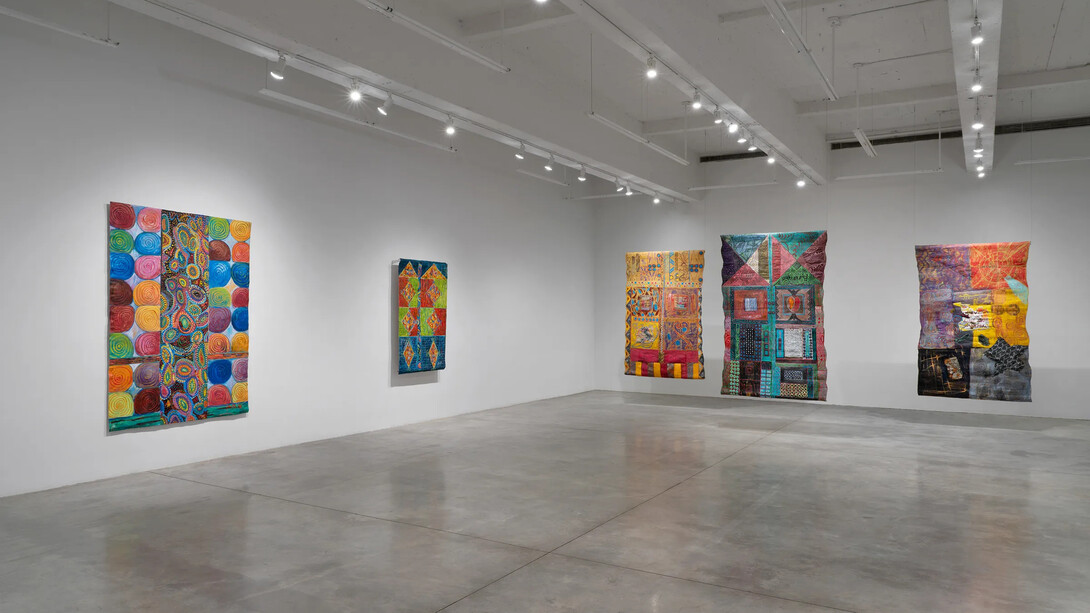
The trip to Yemen was a dream...every day a new idea, every day a new door.
(Pacita Abad, Foreword to "Door to life," 1999)
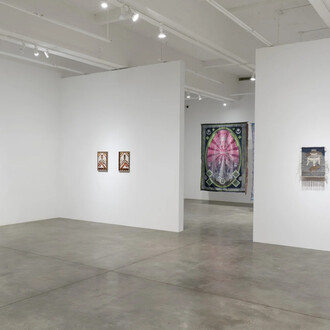
Tina Kim Gallery is pleased to present Door to life, its third solo exhibition of works by the visionary artist Pacita Abad (1946–2004) which highlights a series of works the artist made after a trip to Yemen in the spring of 1998. For years after, Abad created artworks across scale and media that drew tremendous inspiration from the architecture and decorative arts across the country. Including the debut of the artist’s never-before-seen qamariya paintings — references to the traditional stained glass windows of Sanaa — the exhibition will bring together the multiple bodies of work that comprise the holistic Door to life series for the first time.
Abad was a pioneering artist known for her rigorous political engagement and radical embrace of global arts and crafts practices, which she encountered throughout decades of extensive travel. Born to a politically-active family in Batanes, the northernmost province of the Philippines, Abad came to the United States in 1970 where she studied at Lone Mountain College in San Francisco before embarking on her decades of nomadic travel to 62 countries across Asia, Southeast Asia, the Middle East, the Caribbean, and Africa. Although she took courses at The Art Students League and the Corcoran School of Art, Abad stated, “Traveling for me is my art school.” Abad’s practice was distinctly porous, accumulating layers of material, technical, and formal influences throughout her 32-year-long career. Her practice was profoundly influenced by the artisans, seamstresses, craftspeople, journalists, and everyday people she met across her travels. Abad considered her practice to be global rather than defined by any single artistic style or national identity.
The artist visited Yemen during a critical and politically charged moment in the country’s history in the years following the 1994 civil war, and her work urgently engaged with a culture that was navigating significant flux and upheaval. The series is emblematic of Abad’s deep belief in the value of the cultural products and practices of places undergoing political or economic instability. Rather than positioning herself within a nameable lineage of artistic influences who moved in conventional gallery spaces, Abad instead favored the inheritance of historically anonymous workers in craft, textiles, and the decorative arts, from locations outside of established Western institutional and market infrastructure.
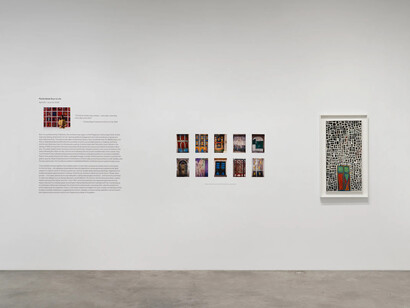
Of particular interest to Abad during her time in Yemen were portals—intricately painted doors and delicately crafted stained glass windows—which she encountered in cities and villages such as Sanaa, Manakha, and Al Mahwit. The artist was drawn to the decorative doors especially, painted in strong, loud, pure colors, softened by the sun and sand and designed with colorful symbols, hearts, flowers, and Islamic verses. She also appreciated the striking parallels between Yemen’s earthen and stone architecture and the traditional stone houses of her native Batanes. Traveling through the country with sketchbooks and a camera in hand, Abad captured the country’s striking architecture, focusing on the designs and colors of the doors and windows that most captivated her attention. Upon returning to her studio in Jakarta, these sketches and photographs inspired the creation of the vibrant Door to life series.
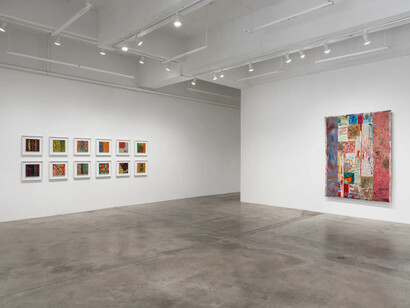
The exhibition includes a number of Abad’s intimately-scaled square Door to life paintings, as well as larger paintings, which the artist made in her signature trapunto style. Significant works from Abad’s Door made of straw series—which were previously exhibited at the 13th Gwangju Biennale: Minds rising, spirits tuning in Gwangju, Korea (2021) —will make their North American debut. In these works Abad rejects the traditional surfaces of canvas or paper, instead choosing to paint onto woven straw mats like those she saw woven by Yemeni women in Hodeidah. She then layered and stitched her artwork with patterned batik and ikat textiles, sourced in Indonesia. The weave of the mats provides a structured grid that echoes the architectural forms in the paintings, but the geometries of the work retain a fluidity and tactility indebted to their hand-crafted nature and their roots in practices that precede twentieth-century aesthetic movements.
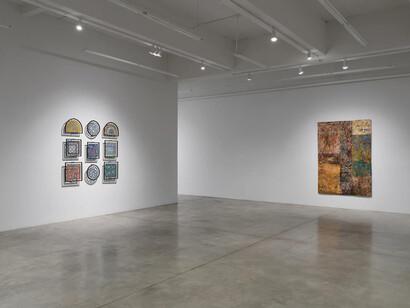
On view for the first time since their creation will be nine paintings which reference the traditional stained glass windows of Sanaa, called qamariya (meaning “moon-like” or “of the moon” in Arabic). These double-sided works are painted onto reappropriated stencils that Abad collected from qamariya workshops in Sanaa. Her vibrant brushwork in the negative space forms a complement to the stained glass windows the stencils helped to produce, as well as an extended collaboration between the artist and the craftspeople who shared their materials with her. For Abad, the painting of the everyday doors and windows of Yemen, was her pathway to show the outside world a vibrantly colorful perspective of the rich cultural heritage of Yemen. As the late scholar James T. Bennett noted in his 1999 essay, “[Abad’s] explorations in Door to life are not in the manner of the tourist’s fading snapshots but a series of striking statements which articulate the language of the heart.”