English
 Español
 Français
 Deutsch
 Italiano
 Português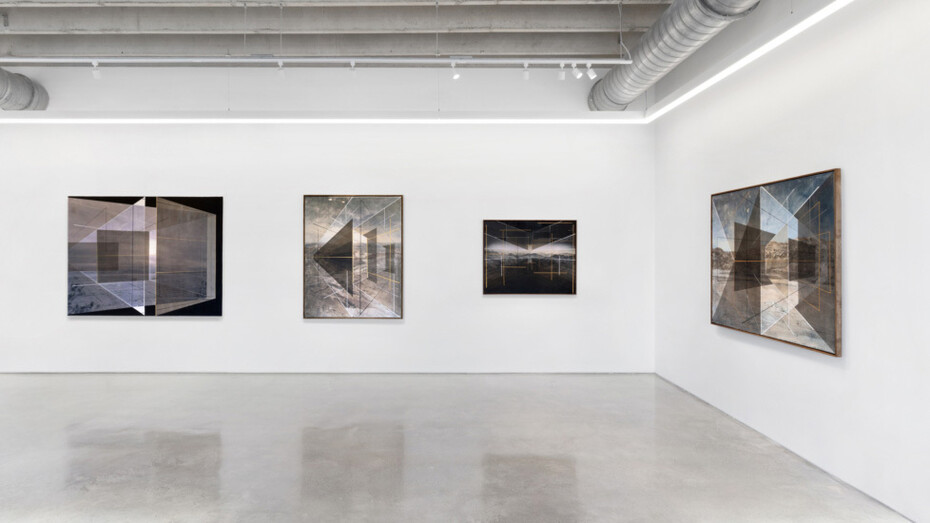
There are no foreign lands. It is the traveler only who is foreign.
(Robert Louis Stevenson)
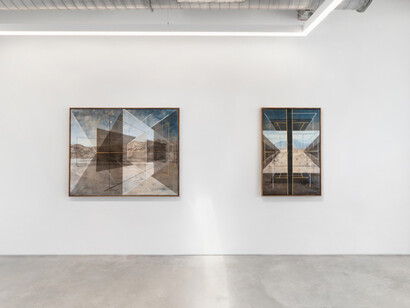
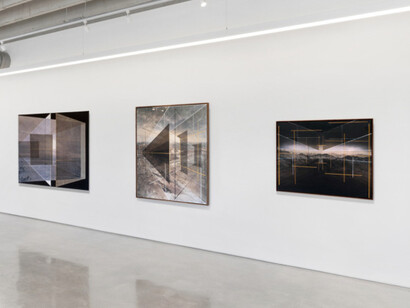
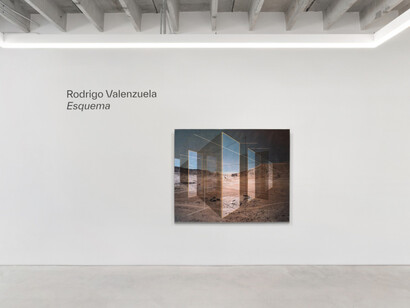
Mindy Solomon is pleased to present the second solo exhibition, Esquema, of California based Chilean artist Rodrigo Valenzuela. Focusing on altered landscapes through the medium of photography, utilizing acrylic and toner on canvas, these one-of-a-kind images invoke a sense of place and displacement simultaneously. Valenzuela writes of his work:
“For most of my 20’s, I was an undocumented worker, where I was far from family and spoke broken English. My practice is informed by that lived precarity, which never leaves you. Borrowing from science fiction and speculative research methodologies, I trace the histories of the Americas and the fraught terms of belonging within those narratives, grounding them in a contemporary context. Social commentary, philosophical inquiry, and poetics converge to examine the Latin American experience as shaped by the often invisible imperialist power. In various ways, my work prompts: What does it mean to be an intellectual of color? How might deeply personal gestures expose the matrices of society and history?
In my most recent photographic series and installations, I studied how modernist architecture in Latin America operated as a Trojan horse for CIA interventions. In other projects, the history of punk across the continent informed ceramics and prints to highlight the gestures of marginalized youth under conditions of state and social repression. In my last couple of projects, I have addressed an ever-present concern: the decline of working-class narratives in the American imagination and as a political force.”
At its core, the exhibition poses difficult questions without resolving them: Who gets to belong? Whose narratives are preserved or erased? And what happens when working-class voices fade from cultural and political visibility? Examining these landscapes, one can be drawn into their apparent vastness and momentarily forget how closely questions of belonging are tied to visibility and recognition. Yet their instability resists passive viewing. In that tension between seduction and rupture, the viewer confronts a quieter unease: that belonging is never evenly granted, but produced through histories that determine who is seen, who is displaced, and who is permitted to feel at home.