English
 Español
 Français
 Deutsch
 Italiano
 Português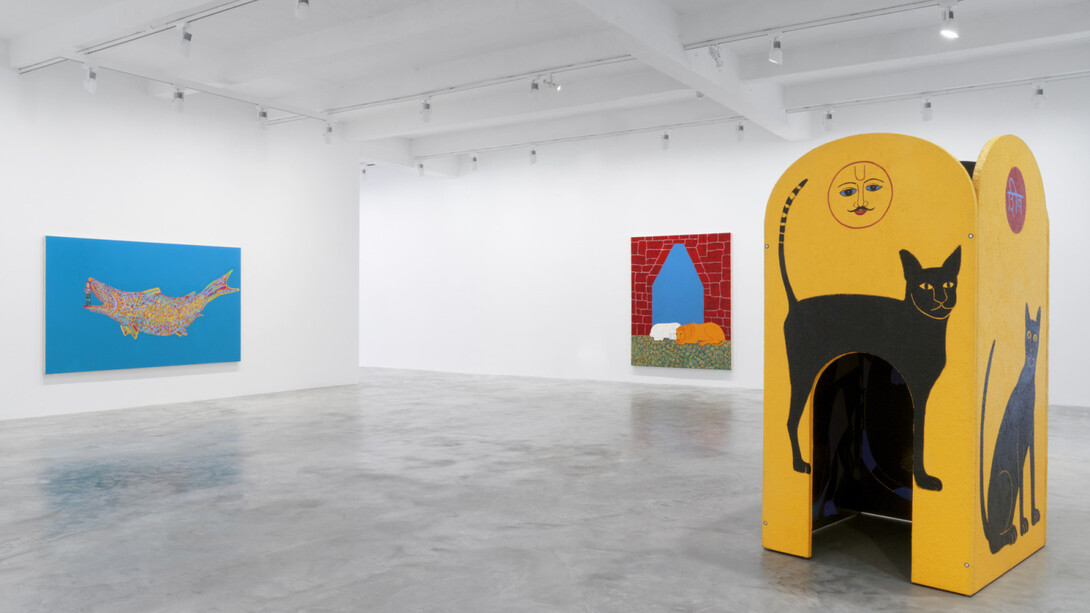
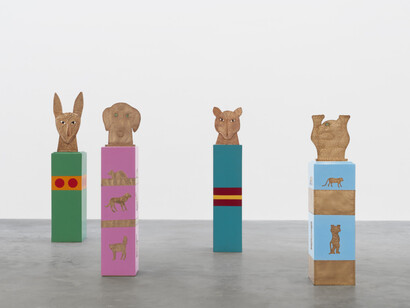
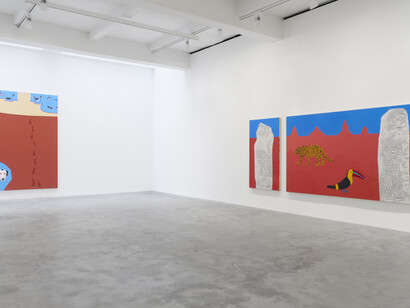
Matthew Marks is pleased to announce Joan Brown: the golden age, the next exhibition in his gallery at 523 West 24th Street. The exhibition includes twelve paintings and sculptures made between 1982 and 1988.
The golden age centers on Brown’s late work, made in the ten years prior to her untimely death in 1990, at the age of fifty-two. These works are marked by unabashedly vibrant expanses of contrasting color, flattened compositions, and a graphic directness inspired in part by Henri Rousseau. The title of the exhibition is taken from the idyllic vision of harmony the artist described in 1985: “The ancient cultures have foretold that a Golden Age will recur. It will be a peaceful time when all creatures on earth will live in perfect harmony.”
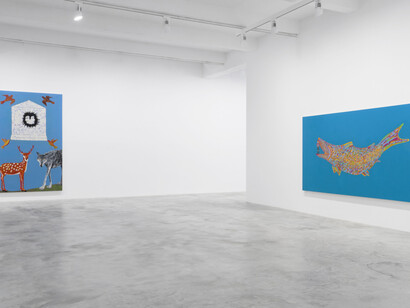
Several of the works on view feature unlikely animal companions, peacefully coexisting despite their natural dispositions—a lion and a lamb, a peacock and a snake, a cat and a rat. The golden age: the deer and the wolf (1985) depicts the two animals alongside a double-faced image, for Brown a symbol of the “celebrated duality of the world,” as one curator has described.
In Brown’s Golden age, images taken from disparate cultures and moments in history are collaged together. In a reimagining of Jonah and the whale, the painting A new age: the bolti fish (1984), depicts a self-portrait of Brown in paint-covered clothes standing inside the mouth of a bolti fish, an ancient Egyptian symbol of regeneration. “Allowing for the unexpected on the canvas,” one critic wrote at the time, “Brown is often a kind of spectator at the birth of her creations, using art as a mirror for her current state of being. Yet she communicates on a profound level.” As Brown herself described, “Images are really just vehicles for me to express all the things I’m in awe of.”