English
 Español
 Français
 Deutsch
 Italiano
 Português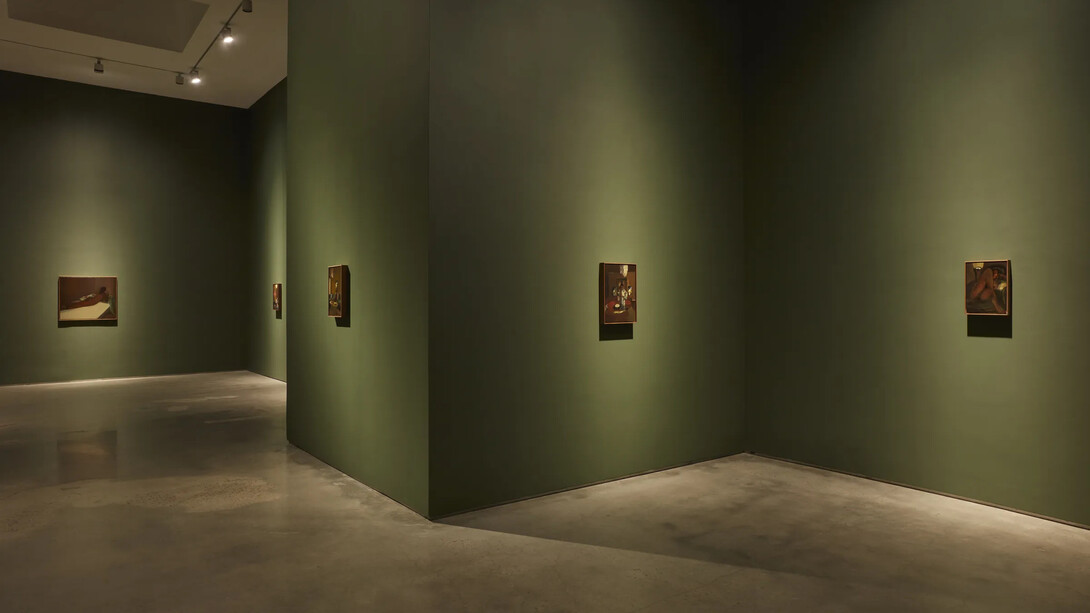
What is required of us is not certainty, but the willingness to remain present to what we do not yet understand.
(Psychoanalyst James Hollis)
Her prayer was scarcely done when a heavy numbness seized her limbs, thin bark closed over her breast, her hair turned into leaves, her arms into branches, her feet so swift a moment ago stuck fast in slow-growing roots, her face was lost in the canopy.
(Ovid, The metamorphoses)
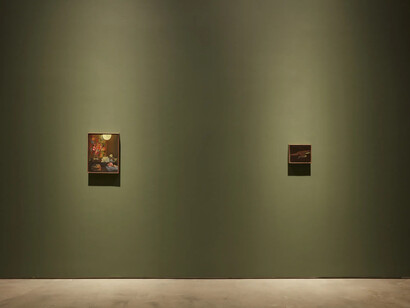
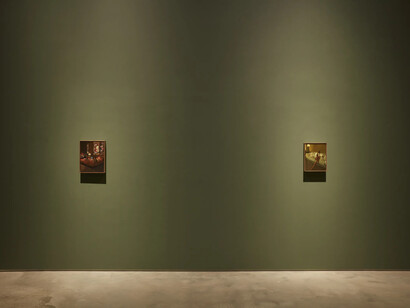
Boesky Gallery is pleased to present Forest for the trees, an exhibition of new paintings and watercolors by Danielle Mckinney (b. 1981; Montgomery, AL). Forest for the trees coincides with Danielle Mckinney: shelter, a survey of the past five years of the artist's practice, on view at the Norton Museum of Art in West Palm Beach, FL through October 4, 2026.
In pensive, cinematic portraits, Mckinney captures solitary female protagonists in moments of leisure and respite. Set in dream-like domestic interiors, the figures in Forest for the trees sprawl across unmade beds, recline atop sleek, modernist furniture, and bask in afternoon sunlight. Unaware of—or perhaps unconcerned with—the viewer, Mckinney’s women smoke, read, and nap, lost completely in the curated comfort of their sacred private spaces.
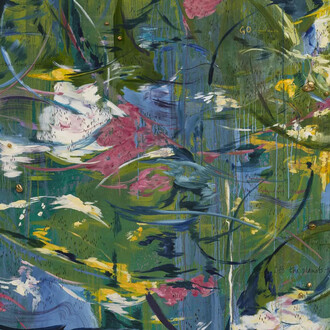
Figures have always been the focal point of Mckinney’s work—expressions, posture, and gestures always carrying more meaning than the particulars of their domestic spaces. With Forest for the trees, the artist loosens her brushwork, rendering her figures with less definition—allowing bodies to melt into surroundings, limbs to dissolve into abstraction. Yet, the environments these figures occupy are more realized than ever before. The brushwork, like that of the figures, is loose and painterly—evoking the intimate, impressionistic domesticity of Édouard Vuillard, the specificity of the imagery only taking form with distance. But the rooms assert themselves: ornate chandeliers and bulbous lamps cast warm light across sinuous, mid-century furniture decorated with floral throw pillows and vases of bright, springy blooms.
This subtle shift in the figure-ground relationship throughout the works of Forest for the trees reflects, perhaps, the environment of their creation. Mckinney made these paintings during a period of particular turmoil, both personally and collectively. The weight of generational change permeates each of the works, the dreamlike domestic realms less polished sets for the performance of rest and more refuge amidst a world on fire. The figures themselves embody uncertainty; the spaces ground them, inviting these women to turn inward, gently holding them as they bear witness to ceaseless change.
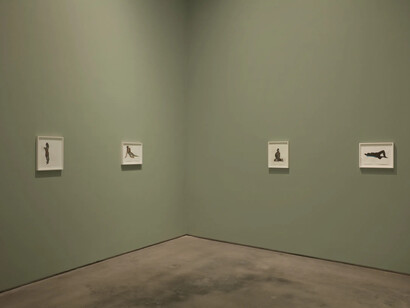
Alongside these ten new paintings, Mckinney presents—for the first time in New York—a suite of watercolors. On paper, Mckinney adopts a particular economy of gesture, conjuring graceful figures in just a few marks, allowing the swell of water-bound pigment to define the contours of the body. Suspended against stark white backgrounds—more exposed than their oil-painted counterparts—the watercolor figures are nevertheless embraced by the artist’s hand, permitted a moment to breathe freely.
Forest for the trees takes its title from an adage first documented in a 16th-century book of proverbs by English playwright John Heywood. “I see,” Heywood recounted, “ye can not see the wood for trees.” For Mckinney, the maxim reflects the particular conditions of this moment in time—of being on the precipice, it seems, of a larger shift. Without the perspective supplied by distance and time, it remains unclear how each small element of change contributes to a whole. This feeling—of being too close to the trees to see the forest, too close to the brushstrokes to see the painting—is articulated rather eloquently throughout the work of psychoanalyst James Hollis. And for Hollis, there is wisdom to be found in living with this not knowing, in being present with uncertainty, in inviting it into our lives.
With Forest for the trees, Mckinney turns inward, searching not for resolve—but for a place where it is safe to sit with this palpable sense of uncertainty. Nothing here is sure—but nothing needs to be sure. In this place—amidst these conditions—Mckinney’s women become trees, free to lay down roots, their growing wisdom pushing deeper and deeper into the earth. And—like the mythic Daphne, transformed into a tree—from these roots, they will grow and blossom.