English
 Español
 Français
 Deutsch
 Italiano
 Português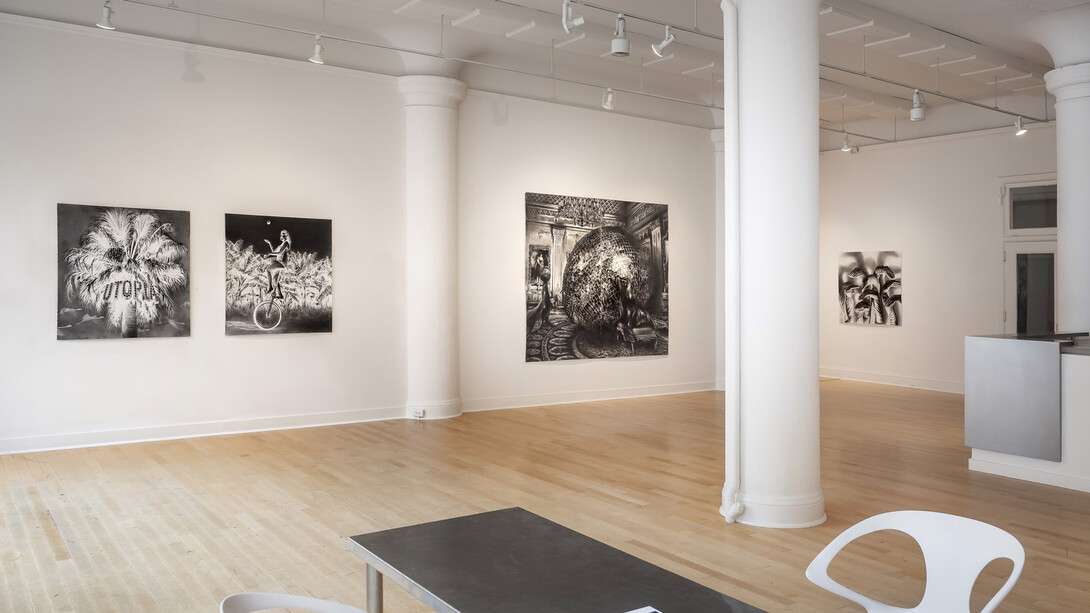
Dolby Chadwick Gallery is honoured to present A certain slant of light, an exhibition of new work by Gonzalo Fuenmayor.
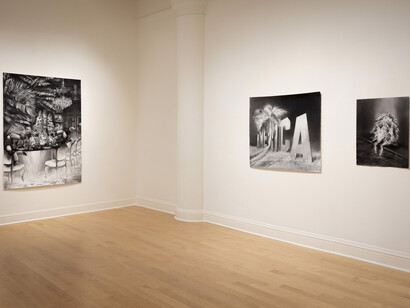
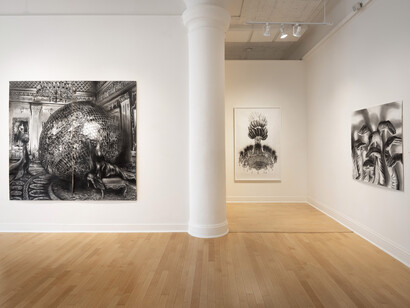
For over two decades, the Colombian-born, Miami-based artist has refined a distinct visual vocabulary that probes, unsettles, and complicates questions of cultural identity. The resulting maximalist compositions trace the contours of domination and desire, examining the mechanisms by which cultures are framed, consumed, and recast through the lingering optics of colonial imagination. A refusal of the exotic unfolds alongside its amplification. Decadent interiors buckle under the slow insistence of tropical encroachment; neatly cultivated spaces retreat as leaves, birds, and ornamental excess press inward. Each gesture shadows the other, entwined in a visual language at once seductive and disquieting. Amid heaps of bananas, fractured chandeliers, and resilient wildlife, nature reasserts itself quietly, insistently against the structures that once sought their containment. A certain slant of light explores these tensions from a shifted vantage, inverted and turned on their head, to find where imposed narratives fray and the performance of power falters.
Fuenmayor borrows his title from Emily Dickinson’s eponymous poem, where light is not illumination in the conventional sense, but a psychic, atmospheric force, difficult to name. Dickinson’s “slant” carries a weight that is both immaterial and deeply felt, a “Heavenly Hurt” that leaves no visible mark yet alters perception from within. Fuenmayor’s use of light operates in a similar register. Light drifts through these works as both revelation and distortion, casting surfaces into heightened clarity while obscuring the structures that sustain them. Most striking are the moments in which Fuenmayor bends and inverts light and shadow, allowing illumination to pool in unexpected places, where glamour slips into excess and spectacle teeters on collapse: in Utopia, an x-ray-like palm tree is labeled in grand marquee lights, set against its counterpart, Tropics. Here, inversion operates both literally and metaphorically: the “light” historically aligned with progress—the colonial imposition of enlightenment—darkens. In Genesis, the chandelier glows black; elsewhere, Utopia ominously names the shadow. In this way, the title points to a shared sensibility: light as a carrier of tension.
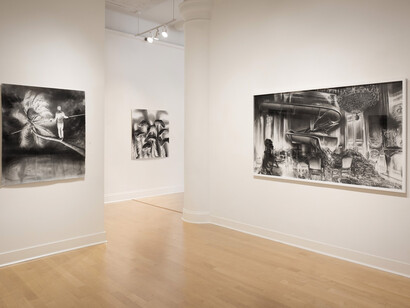
To unpack these tensions, each drawing enters into an ongoing negotiation with power—its symbols, its theater, its quiet violences. In When leaves remember, a Victorian banquet table, set in lavish stillness, is overtaken by a durante of toucans as banana and palm leaves breach the interior. Elsewhere, the chandelier recurs as both emblem and rupture: at times fusing with the pendant bloom of a banana flower, at others dissolving into the fractured gleam of a disco ball. For this exhibition, Fuenmayor adds to his archive of inspirations the decadence of the 80s as a site of disruption, to be interwoven with references to the baroque, to early monochrome cinema, and the circus. Chandeliers give way to the glamorous death of the disco ball, suspended across a lavish ballroom now inhabited by playful seals, or reappearing in the jungle where it crushes the Wicked Witch of the West. Across these shifting scenes, performers recur: a tightrope walker balancing atop a bending palm, a monocyclist suspended mid-act. Again and again, Fuenmayor returns to the circus—the staged spectacle, the performed self crafted for an audience. As the circus presents its illusions with polish and wonder, so too are we implicated, negotiating projections of identity shaped by the expectations of those who observe us.
Among the most arresting images in the exhibition is Carmen leda II. Part of his long-running engagement with Carmen Miranda and her complex performance of identity, the myth of Leda and Zeus unfolds atop Miranda’s iconic headdress. Zeus, now disguised as a flock of swans, rises monumentally, three luminous bodies entwined with cascading crystal and tropical foliage, transforming adornment into a site of tension. Under Fuenmayor’s slant of light, the convergence of cultural icon and Leda’s myth of violence reveals a darker colonial subtext, where spectacle obscures histories of violation and control.
Just as Dickinson’s landscape “listens” under the weight of light, Fuenmayor’s worlds seem to pause within it, caught between spectacle and collapse, awareness and illusion. What emerges is a heightened sensitivity to the unseen forces shaping perception, where illumination becomes less a source of truth than a condition that unsettles it. Rather than resolving these tensions, Fuenmayor sustains and stages them. His work exposes how images of lush, excessive, alluring tropics have been constructed through systems of display, consumption, and control. Interiors and symbols in their overt opulence reveal the historical conditions that produced them, from colonial extraction to the commodification of culture. In this space, meaning is not fixed but negotiated, and the familiar visual language of beauty and spectacle begins to unravel. By refusing closure, these drawings hold us within that instability, implicating them in the act of looking itself: the desire to consume, to categorize, to exoticize.