English
 Español
 Français
 Deutsch
 Italiano
 Português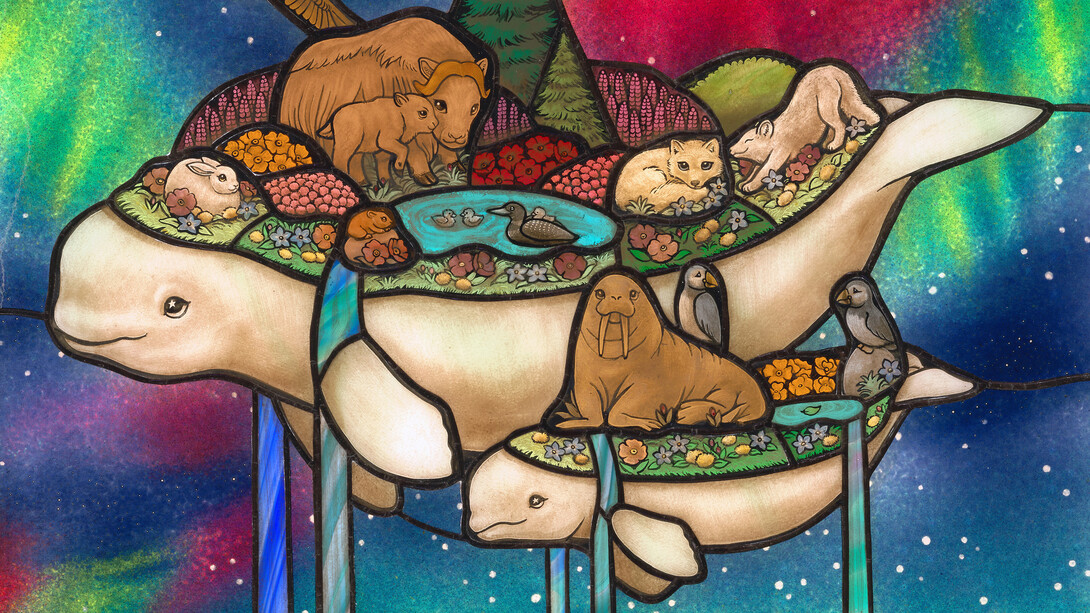
On Saturday, May 16th, Corey Helford Gallery (CHG) will proudly unveil a new solo show from pop surrealist and contemporary painter Andrea Guzzetta, titled Oasis, in Gallery 3.
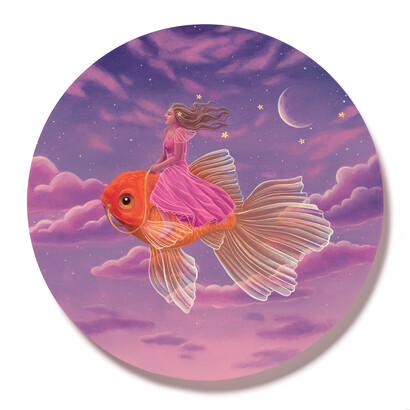
With a practice rooted in curiosity, humor, and reverence for the natural world, Guzzetta invites viewers into a vivid, transportive body of work that offers both visual delight and emotional reprieve. In Oasis, Guzzetta moves away from the expectation that meaningful art must carry a heavy hand. Instead, she constructs a luminous, immersive escape—one that leans into joy, wonder, and the awe of childhood discovery. “I don’t believe art has to be ‘serious’ to be meaningful,” Guzzetta shares. “This art is a little island of hope, a peaceful place you can sink into... in a world that feels increasingly tumultuous and unsafe, I’m offering an oasis. Come, rest here with me.”
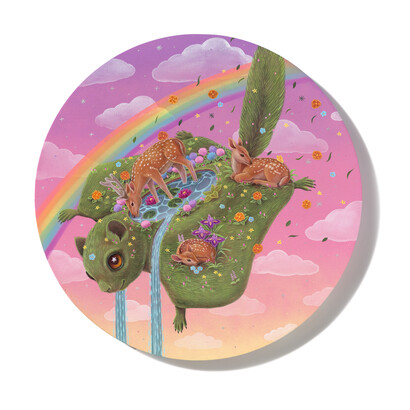
Raised in rural Wisconsin, Guzzetta’s early environment—shaped by open landscapes and a lack of cable television—sparked a deep fascination with animals and their habitats. This influence carries through in her work today, where meticulously researched ecosystems meet dreamlike compositions, creating scenes that feel both grounded and otherworldly. Her paintings often capture fleeting, almost cinematic moments of connection between creatures and their environments, rendered with technical precision and emotional warmth.
Before establishing herself as a full-time artist and garnering a community, she spent nearly a decade working in two of the largest stained glass studios in the United States. There, she contributed to
projects for celebrated contemporary artists such as James Jean and Amir Fallah, while also producing large- scale religious commissions—“including many giant windows of Jesus,” as she humorously notes.
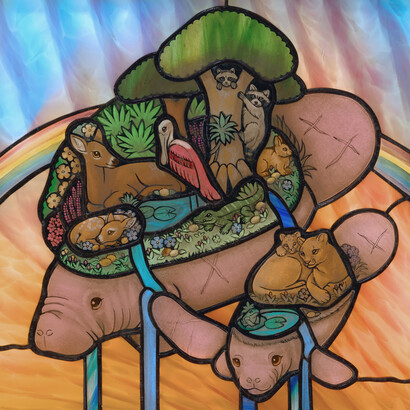
For the stained glass pieces in her solo, Guzzetta explains, “Every piece in this collection was designed by me. I cut all of the glass. Much of it is mouth-blown glass from Fremont Antique, a high-end small-batch company based in Oregon. The background glass for "Beluga Borealis” was created by me using powdered glass called frit and fusing it at 1400 degrees Fahrenheit in a kiln. Much of the glass is flashed glass, a special and very expensive type of glass that is mostly clear with a thin layer of color on top. I then used hydrofluoric acid to etch away the color in parts of the glass leaving the clear behind. After that, the glass was painted using vitreous paints and then fired in a kiln. Vitreous paint is a type of paint that contains small glass particles so that when it is fired in a kiln, it fuses to the surface of the glass becoming a permanent color in the glass. Unlike acrylic or oil paints applied to glass, vitreous paint is completely archival. The oldest surviving examples of vitreous glass
paint are from 1050 AD. These pieces could outlast you, your great-great-grandkids, and whatever aliens tak. e over in the next 1,000 years. Each piece was then soldered together into a single panel using copper foil. All in all, stained glass is an expensive and time-consuming craft, but it’s also a beautiful and sacred tradition that I am honored to be a part of. I hope you like them as much as I do.”
Now based in LA with her giant boyfriend and tiny dog, Guzzetta’s creative path is notably multidimensional. In addition to her visual art practice, she spent five years performing stand-up comedy, an experience that sharpened her storytelling instincts and distinct voice—qualities that subtly infuse her paintings with wit and accessibility. She has also co-hosted several podcasts, including the widely followed Cult podcast, the art history-focused Podvantgarde, and currently, Hey what are you working on, an advice podcast for emerging artists navigating creative careers.
Diagnosed with ADHD later in life, she has spoken openly about how it shapes her approach to artmaking— fueling both her expansive curiosity and her ability to hyper-focus on intricate details. This duality is evident throughout Oasis, where richly layered environments reward a closer look while maintaining an immediate, almost playful visual impact. With Oasis, Guzzetta offers more than an exhibition—it is an invitation to pause, to reconnect with a sense of wonder, and to find comfort in beauty without pretense.