English
 Español
 Français
 Deutsch
 Italiano
 Português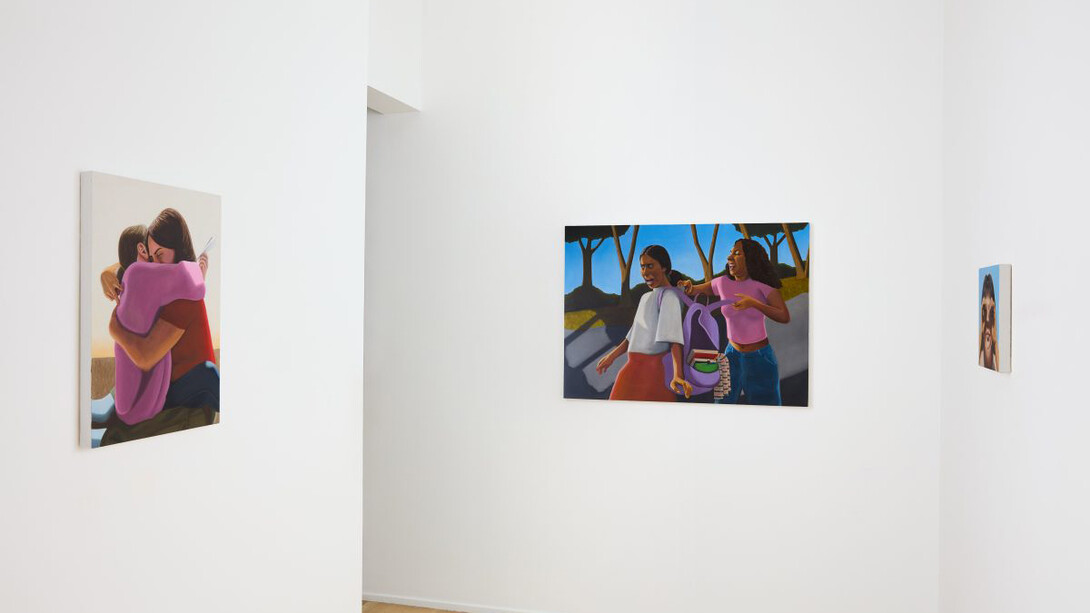
Andrew Rafacz is thrilled to announce Un patio particular, a solo exhibition of new paintings from Berenice Vargas Bravo, in Gallery Two. The exhibition opens Friday, April 10th and continues through Saturday, May 30th, 2026. This is the artist’s first solo exhibition with the gallery.
El patio de mi casa es particular.
Se moja y se seca como los demás.
Agáchense y vuélvanse a agachar.
Los niños bonitos se saben agachar
Los niños bonitos se saben agachar
Chocolate, molinillo
Estirar, estirar, que la reina va a pasar.
Chocolate, molinillo
Estirar, estirar, que la reina va a pasar.My house’s patio is something special.
It gets wet and dries just like the rest.
Lay down low and then lay down again.
Good children know how to lay down.
Good children know how to lay down.
Chocolate, little whisk
Stretch it out, stretch it out, the queen is passing by.
Chocolate, little whisk
Stretch it out, stretch it out, the queen is passing by.
Playful and catchy, the Hispanic children’s song El patio de mi casa accompanies a game traditionally played in a circle, on the interior patios of houses across Latin America and Spain. However, intertwined among its rhythmic, seemingly nonsensical phrases, like chocolate, molinillo, are others that can be interpreted as symbolic of power and control. “Lay down, and lay down again” can be read both as a gesture of reverence or submission toward the queen, and as a bodily reaction to a threat—a way of protecting oneself. Likewise, “stretch it out, stretch it out, the queen is passing by” suggests the formation of a structure in service of power—in this case, a literal bridge made by the children’s bodies in order to let the queen pass. Another line, los niños bonitos se saben agachar, introduces a more ambiguous layer. Bonitos can mean both ‘cute’ and ‘well-behaved.’ In this sense, the phrase implies that those who are good—or pleasing—are precisely those who know how to obey. The song becomes a space where ideas of control, hierarchy, and the maintenance of power structures are rehearsed and embraced through play.
For her first solo exhibition with the gallery, Berenice Vargas Bravo explores these themes in a series of bold new paintings, staging a space where power dynamics are not only revealed but deliberately re-constructed. For Vargas Bravo, play operates as a tool to both expose and subvert ingrained systems, turning a familiar site of play into one charged with dramatic tension and poetic ambiguity. The word patio carries multiple meanings in the Spanish language. It can refer to a domestic courtyard, a schoolyard, or quite conversely, a prison yard. It describes an open yet contained space—often walled off—intended for recreation. The word particular is equally layered, meaning not only private, but also peculiar, specific, or strange.
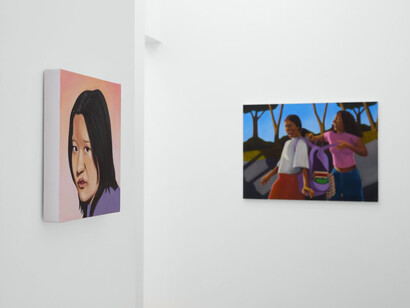
Berenice Vargas Bravo’s narrative mises-en-scène in Un patio particular focus on female figures inhabiting an undefined space that suggests a playground, domestic exterior, or carceral environment. Within it, moments of play coexist with scenes of tension, control, and negotiation. Some of Vargas Bravo’s paintings depict charged interactions between figures—gestures that hover between play, care and aggression—while others present more contemplative or suspended states of being. In La resbaladilla (The slide), two figures are positioned at the top of a playground slide, with one seated at its edge and the other on the verge of falling backwards, reaching out for help. Beneath them, the shadow of a tree stretches across the ground, suggesting a void. The viewer is positioned as a third presence, as if climbing up the ladder and witnessing the scene without intervening. The painting captures a moment of unresolved tension between cooperation and betrayal.
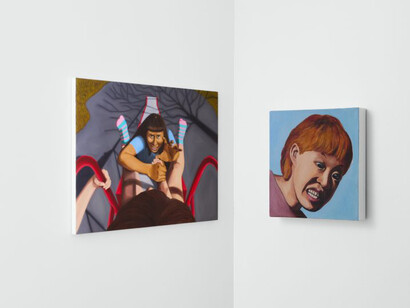
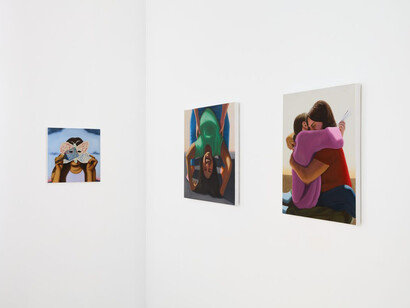
In another painting, La cuerda (The rope), one female figure is bound to another, who struggles and cries out while the other laughs. The tension of the scene is palpable, yet open to interpretation. It is possible that both subjects are in control and could free themselves at any moment. The tension, both real and exaggerated, is suspended between play and potential harm. With Los binoculares (The binoculars), Vargas Bravo seemingly breaks the ‘fourth wall,’ confronting the viewer by depicting a figure looking outward while another, positioned below and not fully visible to us, frames her vision using her own hands as makeshift binoculars. The work questions what it means to take control of another’s experience—to determine what can be seen and known, and how far that can be manipulated by another.
Throughout the paintings in Un patio particular, Vargas Bravo centers female figures in heightened emotional states, as dramatic situations unfold. Referencing the tradition of allegorical painting, where real events transform into mythopoeic scenarios, she imbues her charged compositions with a vivid, colorful palette and a keen attention to light and its narrative possibilities. Vargas Bravo’s scenes feel suspended, airy, and luminous, even as they hold underlying and ubiquitous tensions.