English
 Español
 Français
 Deutsch
 Italiano
 Português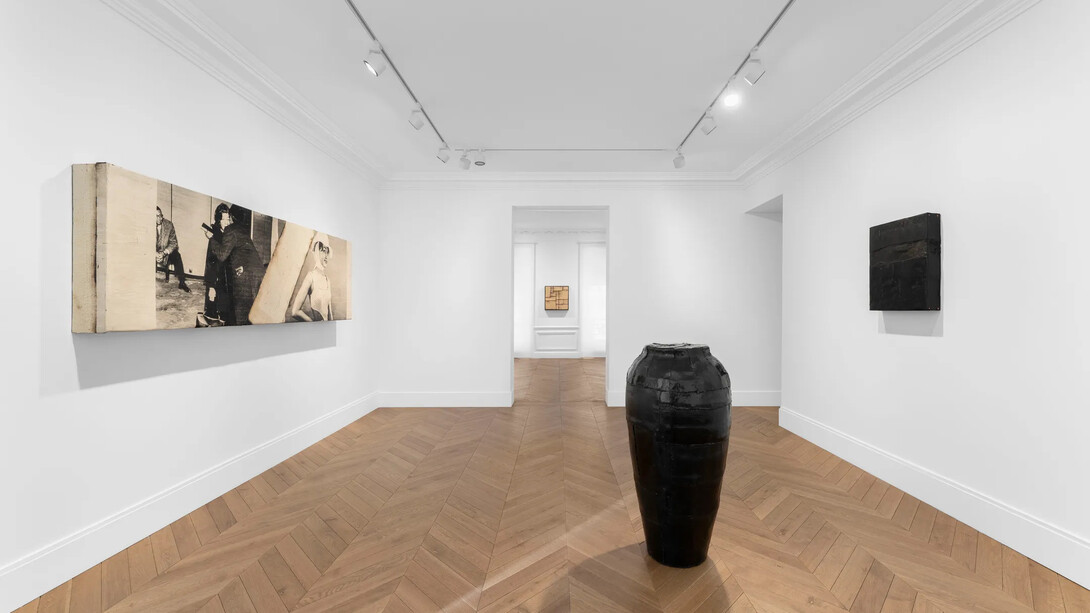
In And other paintings, Theaster Gates brings a central proposition of his practice into relief: the capacity of industrial matter to yield unexpected registers of formal and sculptural articulation. Comprising a suite of new Tar paintings and Tar vessels, Gates draws out the painterly intelligence latent within roofing’s industrial procedures – questions of composition, gesture, scale and colour – mobilising tar as a material grammar through which the terms of painting are rearticulated.
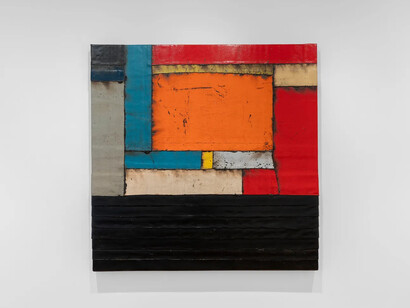
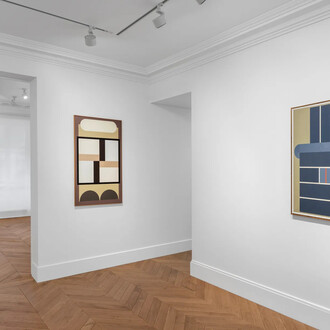
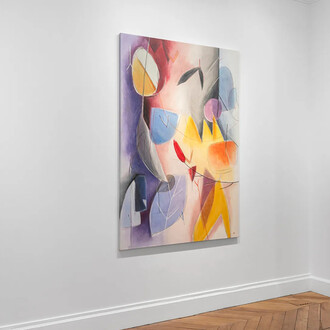
In reappraising painting as a central site of enquiry, Gates’s tar works enter into conscious dialogue with the formal legacies of modernist abstraction. This lineage is most evident in his intensely chromatic, large-scale Tar paintings – including Singed eaves (2024) and The whitest zone to harvest (2025), whose surfaces assemble into passages of hue and interval. While these works invoke devices and techniques such as the grid and colour field, Gates’s procedures operate in tension with modernism’s tendency to abstract material from labour or use. Salvaged roofing substrates are saturated with oil-based enamel, collaged and fused with a hand torch, so that the painted field accrues sculpturally. The resulting works assume an architectural facture, folding tar’s own industrial logic into a painterly syntax irreducible to its modernist precedent.
This vocabulary of tar, bitumen and enamel has been developing within Gates’s work for over a decade, though its origins reach further back into his formative years. Having learned to tar roofs alongside his father, a roofer by trade, Gates has spoken of this early experience as ‘his first art practice’ – an attentiveness to procedure and form that continues to structure his approach to abstraction. Since initiating his experimentations with tar in 2011, this body of work has remained one of the most enduring and generative strands of his oeuvre, repeatedly reopened through shifting strategies: at times assuming monumental proportions, at others densely layered with archival imagery or the visual lexicon of Black liberation movements. Across these iterations, tar operates as a material of transference and inheritance: an homage to his father’s trade, and a means of carrying forward the often-unseen craft of working labour into the language of painting.
In the present works, Gates draws upon his training as an urban planner in paintings such as Land map – Ag majority (2025) and Concerning forested areas and other mixed uses (2025), whose titles appropriate the technical language used by regional planners, land surveyors and transportation engineers to interpret agricultural and suburban maps. The paintings’ discrete regions of colour recall the aerial schemata of land use maps, where colour-coded zones demarcate classifications of terrain, bringing painting’s formal operations into correspondence with the spatial grammars of the built environment.
In a recent suite of smaller-scale paintings, Gates pursues a pared-back palette. Near-monochromatic passages of ivory, turquoise or reflective silver register what the artist has described as an ‘industrial chromatic charge’, their surfaces unfolding into colour fields traversed by borders of expressive weathering. In certain paintings, Gates introduces archival imagery, drawing the figural into the abstract field – sites where his formal concerns in painting come into proximity with his long-standing custodial work with archives central to Black social and cultural history.
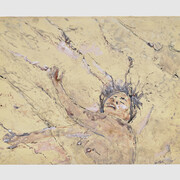
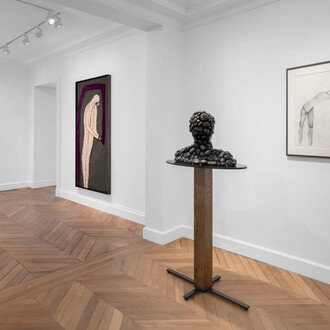
One such point of return is the Johnson Publishing Company collection, which finds renewed expression here in two photo-transfer tar paintings, She never leaves her purse (2025) and Critical crowd (2025). Founded in Chicago in 1942, Johnson Publishing – through its landmark magazines Ebony and Jet – played a formative role in shaping self-determined representations of Black American life throughout the 20th century. Approaching this material as a reservoir of visual propositions to which he returns over time, Gates has spoken of these images as awaiting their ‘next life’ – redeployed throughout his work, they continue to affirm ‘the power of Black identity’. Here, the images are absorbed into the tar surface, their figural presence partially cropped and obscured by interventions of enamelled tar. Gates manipulates the compositions towards diptych-like divisions, drawing archival memory into the paintings whilst altering their conditions of legibility within an abstract architecture in which new relational possibilities are brought into play.
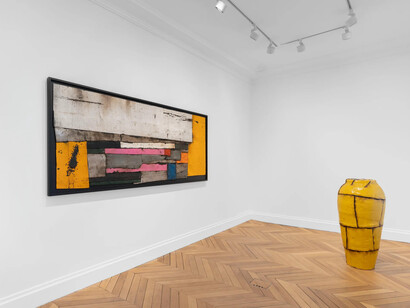
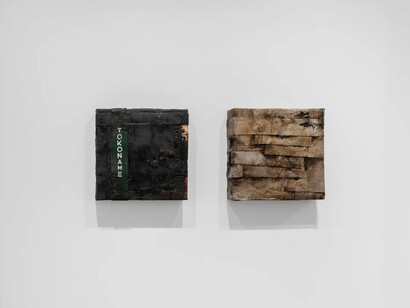
One of three heavily aggregated, burnished black tar paintings in the exhibition, Tokoname study (2024) is distinguished by its incorporation of text: a vertical inscription names Tokoname, the city in Japan to which Gates travelled in 2004 to undertake a training residency in ceramics. That formative period of study, and the discipline of Japanese craft traditions more broadly, has been a longstanding point of reference within his practice, finding sculptural articulation here in the artist’s Protected vessel works (all 2025). While gesturing towards clay as a foundational material in his sculptural practice, the vessels mark a new direction: each form is cast in plaster, then bound, wrapped and sealed in roofing skins, the act of encasement functioning as a gesture of care and preservation, akin to embalming, imbuing the works with an elegiac presence.
In And other paintings, Gates reconstitutes materials whose formal virtuosity and ritual investment are held in parity. Though latent with material meaning, the works never cede the impact of a first impression or direct encounter; as if privileging the formal were a gesture of liberation, Gates observes: ‘For the first time, it’s not really about material… it’s about the paintings.’