English
 Español
 Français
 Deutsch
 Italiano
 Português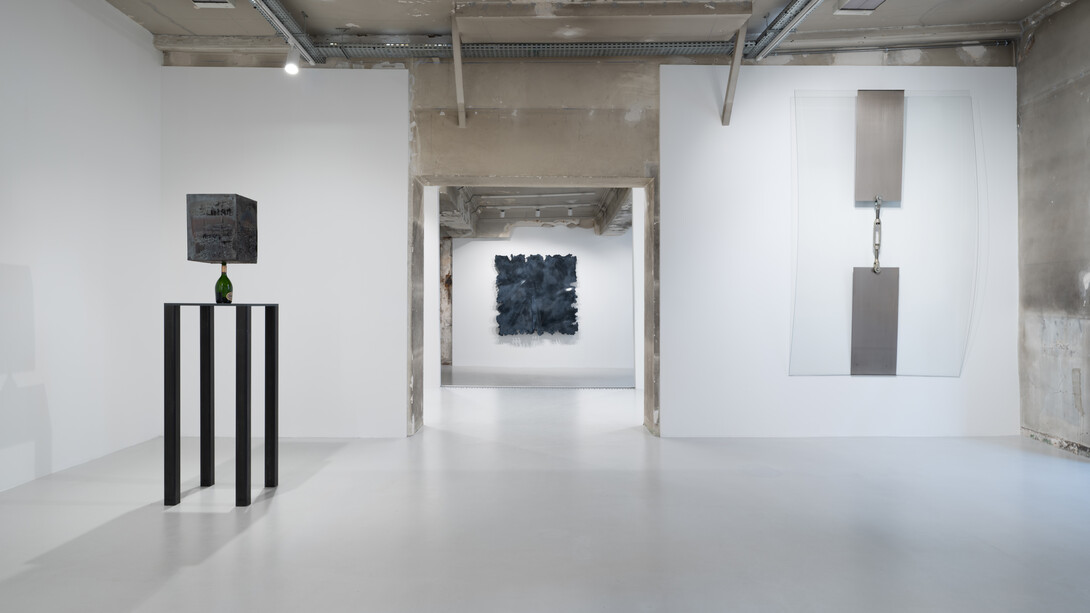
Galleria Continua is pleased to present, in its Paris space in the heart of the Marais, Aux abord du séisme (On the verge of the earthquake, in english), a solo exhibition by Arcangelo Sassolino. The exhibition brings together new works and historical series by the artist, attesting to his ongoing interest in exploring the physical limits of matter and the transformative processes that shape it.
In pursuing the aim of capturing the transformations of matter, and thereby fixing the present moment in its precarious state of balance, Sassolino’s works arise from mechanical actions capable of altering matter’s condition, bringing to light the very process through which form emerges. This founding principle of his practice is evident from the outset of the exhibition with the large-scale installation La consistance du vide. Here, a block of marble bends a glass surface, leaving its imprint in the curvature imposed by its weight. The table now exists in a fragile equilibrium, liable to shatter at the slightest change, physically embodying the constant tension that runs throughout the exhibition.
For the artist, “ destruction is never absolute; it is always a passage toward something else. What collapses generates. What burns leaves a trace. What breaks reveals another structure.” This philosophy materializes in the installation Damnatio memoriae, consisting of a machine that gradually consumes the marble torso of a sculpture. The title refers to an Ancient Roman practice aimed at erasing all traces of an individual from collective memory: their face was removed from sculptures and reliefs, and their name erased from inscriptions when they were accused of treason or deemed unworthy. In the installation, the slow erosion of volume and the subtle alteration of the work’s appearance call into question the representation of history, the distortion of collective narratives, and the possibility of reshaping perception.
The destruction of the sculpture does not simply coincide with its disappearance: the form gradually disperses into space, dissolving back into the material from which it originated. What vanishes is the image, while the matter itself continues to exist in other forms.
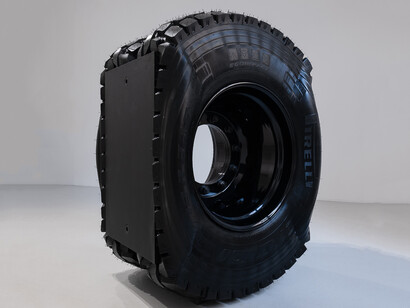
At the core of Sassolino’s practice lies the concept of conflict, understood as a tension between materials, pressures, weights, and heights, placing each work in a permanent state of potential danger. In the exhibition, three works embody this idea : Forêt primaire in wood, Après l’après in glass, and Géographies comprimées in marbles of various types and origins. Suspended and held in place solely by a clamp, these slabs remain in precarious balance and could fall at any moment should the mechanism loosen. These sculptures reveal both the apparent autonomy of the work and the intrinsic force of matter which, in Sassolino’s practice, seems constantly to seek liberation from the constraints imposed by the artist, submitting instead to the physical forces that govern it. Despite their apparent immobility, they appear activated, inhabited by a latent movement that endows them with a potential dynamism.
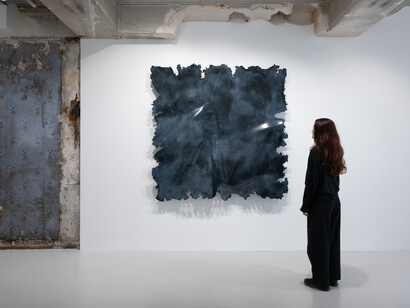
Under Sassolino’s hands, materials seem to alter their very nature, taking on new properties. This is particularly evident in his series Le sédiment de l’action, in which concrete is crumpled as though it were a simple sheet of paper, appearing as a far more flexible material than it truly is. By subverting the physical properties of materials in this way, the artist disrupts our perception of their strength and limits. A similar reflection appears in another emblematic series, Le temps plié. In these works, Sassolino seeks to capture the moment when matter changes state by bending glass to its maximum point of tension. This fragile and rigid material thus becomes a metaphor for time: a dimension that escapes all control and flows inexorably. Through this gesture, the artist appears to suspend that flow, making it momentarily malleable. Time emerges as a dimension that can be symbolically manipulated by the artist, echoing our own perception of time, which varies according to how we experience it, while its course, grounded in the succession of natural and human events, remains immutable.
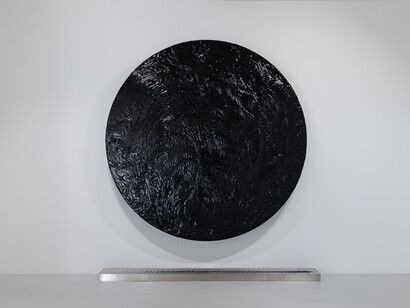
The exhibition unfolds as a site for observing change, where also the artwork may depart from its usual stillness and transform before the viewer’s eyes. By pursuing his challenge to render visible that which, by nature, cannot be captured, Arcangelo Sassolino has recently begun working with a highly viscous synthetic industrial oil, in his search for a material poised in unstable equilibrium between liquid and solid states, capable of questioning the very notion of sculpture as a fixed form. His rotating sculptures, composed of a mechanism in slow continuous motion and a surface entirely covered with oil, transform under the viewer’s gaze, revealing at every moment new forms that appear and disappear across the dense, glossy surface of the fluid disc. In its persistent fall, as the title of the work suggests, matter continually yields to gravity. Despite the movement of the surface, droplets detach from the main fluid mass, introducing a continuous loss that escapes any attempt at containment and revealing loss itself as a condition of existence.
Transformation, evolution, and impermanence remain at the heart of the laws that govern the world, compelling us to constantly adapt to new conditions in order to move forward. In the same way, the exhibition unfolds within a fragile and never entirely stable equilibrium, where matter seems at any moment capable of tipping into total dissolution. Arcangelo Sassolino thus brings the power of gesture and action back to the fore, as forces capable of effecting change, thereby drawing a powerful metaphor between artistic experience and reality.
![Mary Cassatt, Fillette dans un fauteuil bleu [Enfant dans le salon bleu] (detail), 1878. Courtesy of Musée d’Orsay](/attachments/3ddcf3630b2e6b21d055a8488350d949784be8fa/store/fill/330/330/9b97dc5b17cad42577b6453f0968e961b1231ceb2b8b5ceb2c09057b2695/Mary-Cassatt-Fillette-dans-un-fauteuil-bleu-Enfant-dans-le-salon-bleu-detail-1878-Courtesy-of.jpg)