English
 Español
 Français
 Deutsch
 Italiano
 Português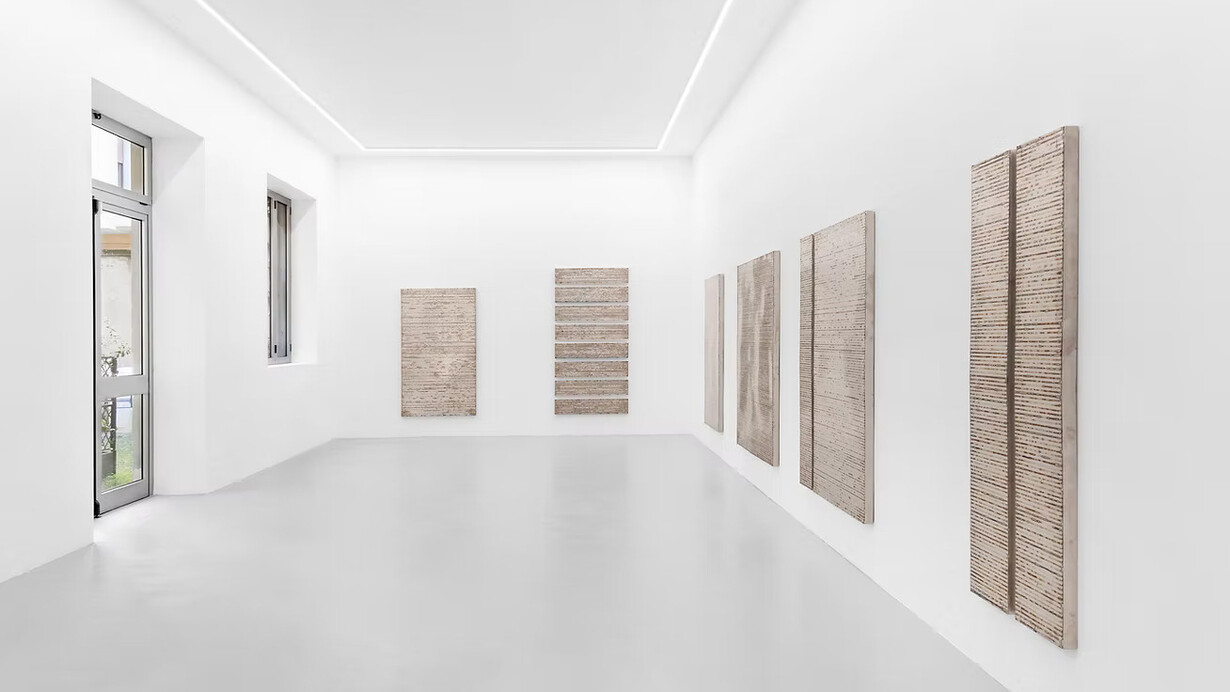
There are lines that cannot be learned by heart, lines we recognise because they have been travelled along, climbed or feared. The one that appears before me is not straight, not stable and not reassuring: it is a line that wedges itself in, that rises and plunges, that traces an irregular ridge like the profile of a mountain coming into view. It has the same rhythm as the outcrop above Stromboli, that sharp ridge that juts out beyond the edge of the crater and which topographical maps render with a broken, nervous line, as if the squiggle itself were designed to express the inner tension of the earth itself. It is not a mere point of culmination: it is a threshold, a line that always seems on the verge of giving way to the left or the right, embracing the precipice on both sides.
I saw that line on the maps before setting out along the hiking path; I saw it where the pathway narrows and the sea opens up below, when the crumbly ground crunches beneath my shoes and every step is a balancing act poised between ascent and fall. I saw it on days when the volcano fumes unspectacularly, holding back its energy; when magma remains invisible yet present, compressed deep inside its internal chambers. It is a line that is both high and very deep. As above, so below. Every ridge is also a furrow, every relief gives way to an abyss. What emerges is always the flipside of what smoulders below the crust.
Another ridge comes to mind, closer to home but equally familiar: that of Pizzo Freddo, a small hamlet in the Oltrepò Pavese, that most exposed to the elements, where every winter the snow falls without fail, and the hillside starts to take on all the trappings of the mountainside. It is the last outpost before the land climbs steadily towards the Apennines and culminates in Monte Lesima, the peak with a name that echoes Hannibal’s passing and which, on a clear day, even offers a glimpse of the Ligurian Sea. Lombardy to the right, Emilia to the left: a ridge that is very much a border, holding two regions together without belonging entirely to either. There too, the land is whittled down to a thin line and the landscape rests on a knife edge. There too, the wind toils like a patient alchemist: eroding, transforming, changing matter from one state to another without us noticing.
When I look at the artist’s works, I think not of a surface but of a topographical threshold. A point where matter has been raised, compressed, fused and then left to cool. A process of transmutation in which invisible heat takes on form, and form preserves the secret of the fire that generated it. A dance of margins that never finds the calm of the straight line. A geography that preserves the echo of a past eruption and the promise of future movement, as if each crest were both wound and mending, separation and union, the high and the low mirrored in a single gesture.
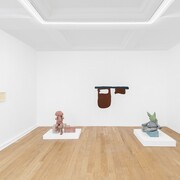
Matisse Mesnil is no stranger to landscapes. Born in the hills of Valdichiana and having moved across the French border throughout his childhood, he seems to have crossed many during his recurring travels on either side of the Western Alps. He certainly still does so, dividing his time between the two countries and gathering visual notes along the way. He often transfers them onto metal, which he deems to be the material best suited to his technical and methodological experimentation. Mesnil welds and grinds, scratches, engraves and alters. He is not bound just to steelwork, and often delights in other materials– basted canvas, photographic print, fabric – yet whatever the chosen medium, his works always reveal the same impulse to define and inscribe the surface as if it were a plot of land, a field or a piece of ground. Sometimes he depicts aerial views, more abstract and summary, while at other times he embraces lake views, domestic scenes or even still-life images.
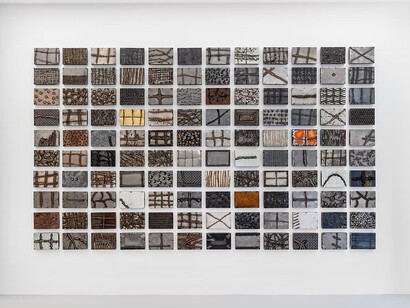
Mesnil masters the interaction between electrode and matter, regulating the combustion to reach a temperature at which a red dwarf burns, to the point of agitating the very molecular structure of steel. The result is an iridescent, well-defined yet imprecise line: a suture that highlights a zone of convergence, a boundary that mirrors the exclusive prerogative of the artist’s sensitivity. Sometimes he carries out his compositions on large-format supports, while at other times he focuses on small panels, icons or perhaps tiles he decorates with a range of different motifs, lines and styles [Tra i lembi, 2026]. Upon closer inspection, when these are all close together, arranged according to the rule of abscissas and ordinates, they look somewhat like microscope slides. Committed to showing the potential magnification of what is infinitely small, in the scale of cells or molecules, these works once again recall the minimal grammar of those views that make up the very essence of Mesnil’s practice.
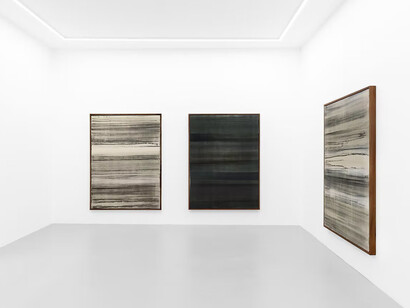
Night has fallen. Not like a curtain, but like a blanket slowly being drawn over the surface. A horizon may be glimpsed without ever being fully revealed: a denser strip crosses the field, retaining the residual light and allowing the rest to disperse into dark vibrations. It is like when the sun has just set, but its echo still remains on the water’s edge; or when the moon, still invisible, casts its very first reflections on the surface. Or when a storm has just passed and the water has ceased to churn, but it has not yet forgotten the power of the wave gone by. There is nothing dramatic, yet all is aquiver.
lines overlap in an almost hypnotic rhythm. They are not perfectly parallel: they thicken, dissolve and touch, with minimal variations that stop the vision from ever stabilising. Each image is unique, just like every instance of light on the sea that is never repeated identically. Even when the scene seems to repeat itself, a more opaque veil, a darker reflection, a shadow sliding sideways shifts the balance of the entire field. In these nocturnes, calm is not stillness but rather suspension. The horizon holds together what is darkened above and what is reflected below, in a silent correspondence that crosses the entire surface. The disturbance spreads both ways, as if the central strip were merely the area of greatest concentration of a larger movement. There is no symbolic statement but only visual traces: what happens in one area is mirrored in the other.
Then something changes suddenly. It is not simply a brightening; the expanse itself is lit up with sharper contrasts. The bands become lighter and darker, almost dazzling in the sunlight that casts shadows, and what was previously restrained vibration becomes exposure. In the lighter fields, there is no pacification but intensification: the light digs in, engraves and separates the strips previously merged with greater determination.
The landscape remains the same and yet it is no more. It is no longer just a suspended nighttime seascape, but an expanse crossed by violent chiaroscuro, by contrasts that almost turn the horizon to a luminous blade. While a vigilant calm prevails in the nocturnal scenes, here a more exposed tension emerges, a reverberation that amplifies every difference. It is not a matter of shifting from night to day but from concentration to transfiguration. The line doesn’t lose continuity: it becomes more visible, more contrasted, more susceptible to light.
Like a nocturne that entrusts darkness with the task of revealing the intensity of a glow by contrast, the monotypes on display are positioned on a threshold: between painting and print, but also between gesture and duration. The artist works on a plate – a temporary surface, incapable of retaining the application – and entrusts the emergence of the image to the contact with paper, which is only completed at the moment of its detachment.
The process is repeated and, layer after layer, the sheet records the sum of achromatic shades that accompany the eye from white through to black and vice versa, sometimes affording the discreet deviation of a bluish tint or – more rarely – a vibration tending towards ochre. Here, stratification is not a mere procedure but a hint of settling time. [Vedute miopi, 2026].
However, it is in the steel works that the themes of duration, repetition and seriality are given their most radical formulation. While time is manifested in monotypes as a succession of contacts, in steel it is expanded into a rhythmic and continuous crossing of the surface. Mesnil organises the silent field of metal by tracing a sequence of horizontal, essential and repeated welds. Upon closer inspection, the support reveals slight volumetric alterations: barely perceptible depressions, interferences that disrupt the apparent continuity. The parallel lines do not put together a complete image but hold it in a state of latency. The gesture is repeated until it gives rise to a dense, essential weave in which minimal variations break up regularity and highlight deviation, friction and resistance, heralding the potential for a language or a form of binary code: dot, dash, dash, dot. The field of perception is broken up; the gaze is invited to pause, to measure the formal differences, to acknowledge a form of meditation in repetition. And the same slow time that the production of the work required of the artist is now translated into the stance of the observer, whose gaze is invited to settle here.
Seriality doesn’t represent a procedure but a condition: for Mesnil, to repeat is to remain in the act without ever consuming it. The metal surface becomes a place of slow sedimentation, where time accumulates like restrained tension. In this sense, the repetition of the mark takes on the connotations of penance, understood not in a moral or religious terms but as a practice of concentration and endurance, permanence, and reflection. The engraved metal thus reads like a scriptio continua in which words flow on from one another without spaces or punctuation, without distinction between lower and uppercase letters: each mark is both trace and time, gesture and sedimentation. [Archéologie punitive, 2026].
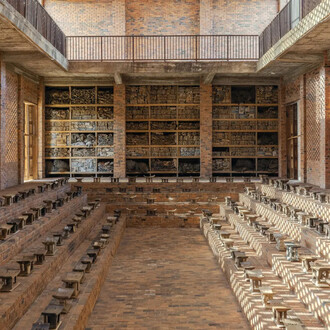
The walls have already all been claimed. No longer by images, but writing that repeats itself until it saturates the space like a continuous code, a grammar that cannot be read but only absorbed. Sitting becomes inevitable. A long metal bench does not invite rest; it imposes a posture. The body aligns itself with the engraved horizon running all around; it joins the rhythm and is traversed by it. We no longer contemplate a landscape; rather, we are inside a language. The lines that once stretched out like seascapes now surround and enclose us, constructing a perimeter. Silence is not an acoustic effect but a physical consequence. Metal absorbs light and reduces its dispersion, focusing attention. Remaining seated means accepting a discipline, a form of waiting. Nothing happens, yet everything is geared towards persistence. Repetition is not decorative; it’s an exercise. Every slight variation interrupts the automatism of the gaze and brings it back to the detail, to the crack, the margin.
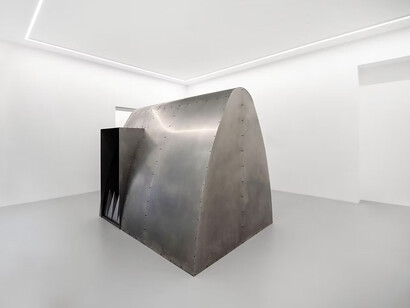
Then there is the other space. No longer the inhabitable room but a volume that stands as a threshold. A sculpture that is already architecture. An environment that fits into the path of a research that has been questioning forms of being and living for years, conceiving space not as a mere container but as an active condition of experience. As you enter, the light changes nature. It is not excluded: it is retained, compressed. The dark walls do not reflect the image of those who pass through them; they swallow it up. The interior is not vast but sufficient: just enough to feel the weight of the material and your own breathing. It is here that the form becomes more concentrated. It’s reminiscent of a chapel stripped down to the bare essentials, a voiceless confessional, yet without evoking guilt nor absolution: it is a space of permanence and measure, in which gestures are repeated and exposed to duration. The darkness protects and exposes at the same time. Anonymity becomes a condition, not an effect. It is unclear whether what is happening is waiting, a clandestine encounter or merely permanence.
The threshold doesn’t distinguish clearly between the sacred and the profane: it suspends them in restrained tension.
Entering L’abri (2026) – a title that recalls Willy Guhl’s Niche à chien (1960), a minimal volume obtained by folding a single industrial material and designed as a kennel, therefore as a form of protection but also the assignment of a place – means accepting a transformation of role. By enlarging that silhouette to the scale of the human body, Mesnil preserves its structural essentiality but shifts the meaning: not refuge as a promise of comfort, but abri in the most literal sense of essential shelter, a condition of subtraction that exposes the body to its own measure. No longer the onlookers of a suture, but part of its continuity. The incisions that before ran across the metal like landscapes are now translated into direct experience: one does not observe the boundary; one inhabits it. And in this silent crossing, between shadow and reflection, between discipline and potential, the space is revealed for what it is: not a container of works but a device for concentration. A place where matter becomes the condition and the body, at last, the unit of measurement.
Small points shoot upwards, their lines intersecting high up and converging to form a sharp apex. Whether they are thorns, spines or mere geometric abstractions, we cannot know, but what is clear is their hostile nature. They are not individuals but a collective body, recognisable as a whole [Virale, 2026]. Such sharp presences crowd the space in large numbers, seeming to multiply, filling it with almost ritualistic discipline. The slender, dark pyramidal shapes are arranged in a tight order, akin to a defensive logic or perhaps spontaneous growth. Taking a few steps back, squinting and abstracting just enough, they may evoke a mineral landscape or a coniferous forest, yet any suggestion is halted by their primary nature: that of devices. The sharp tips have no ornamental purpose but rather serve to signal a boundary. If anything, they may recall spearheads or defensive elements, part of a hostile architecture, an urban grammar that designs space to hinder its use and to discipline bodies rather than welcome them. And while the gaze questions and challenges what is perceived, the work once again evokes a landscape of the mind, ambiguous and impossible to decipher completely, where protection and control give way to threat, where nature and artifice dance promiscuously, where rituality and discipline coexist in an unstable, constantly renegotiated balance.
In this space of tension, Matisse Mesnil’s research is situated in a frontier region: a profile, a ridge, a contour line where matter is exposed without ever being declared. Like the ridge of Pizzo Freddo, which does not belong entirely to either of the sides it divides, or like the sharp peak in Stromboli, which holds magma in its belly, Mesnil’s work inhabits an active margin, a threshold where intensity is restrained, compressed and vigilant. From this economy of retention, a topography of signs takes shape, guarding the memory of a thrust and – at the same time – the latency of further movement; a path in which high and low, separation and conjunction are all inscribed in the same rhythm.
The arrival at a more austere and minimal grammar corresponds to a choice of subtraction: reducing in order to highlight a barer structure, where meaning is formed through accumulation and repetition. It is a form of restrained, almost ascetic minimalism: the surface is organised into repeated fields and infinitesimal differences, as in certain musical scores where the meaning is hidden in the gaps, the cadences and pauses. Yet unlike a closed geometry, the work doesn’t seal off the world beyond the work: it allows it to filter through in the thermal vibration of the welding, in the unpredictable iridescence, in the slight yielding of the material.
And on this horizon, Sutura gives a name to an act that establishes continuity by taking discontinuity as its own condition. It is not the idea that dominates the material: it is the material that reminds us that every idea, in order to exist, must pass through a body.
(Text by Milovan Farronato and Chiara Spagnol)
![Mary Cassatt, Fillette dans un fauteuil bleu [Enfant dans le salon bleu] (detail), 1878. Courtesy of Musée d’Orsay](/attachments/3ddcf3630b2e6b21d055a8488350d949784be8fa/store/fill/330/330/9b97dc5b17cad42577b6453f0968e961b1231ceb2b8b5ceb2c09057b2695/Mary-Cassatt-Fillette-dans-un-fauteuil-bleu-Enfant-dans-le-salon-bleu-detail-1878-Courtesy-of.jpg)