English
 Español
 Français
 Deutsch
 Italiano
 Português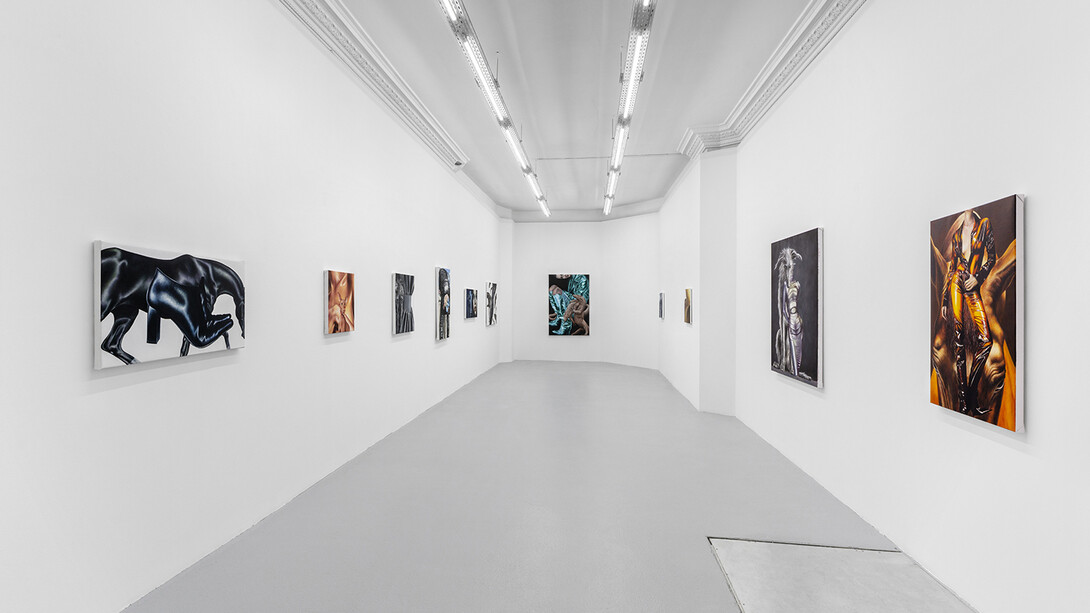
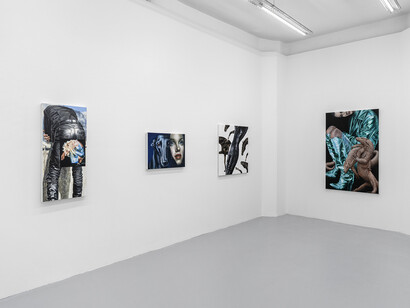
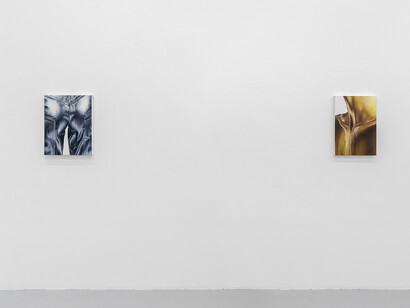
Margaux Valengin’s latest paintings consider corporeality as both artifice and animality, staging richly ambiguous fables of bodily aggression, protection, and vulnerability, often between paired beings. The bodies that populate these works evoke darker, more inward-looking, and more explicitly psychic moods than in her recent paintings, and frequently confront the viewer through a direct address imbued with a kind of iconic authority. Whether human, horse, dog, or cat, these taut, articulated, fragmentary figures silently project defiance, protection, sinuous arousal, nocturnal menace, or melancholy.
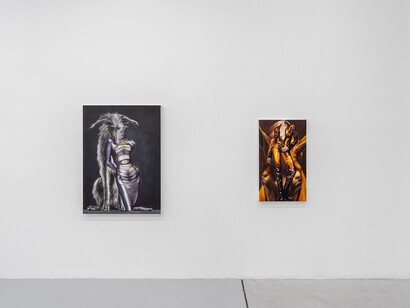
A recurrent pairing in Valengin’s new works is that of a guardian animal with a clothed female body, as in Grimes (2025), Un, deux, trois, quatre, l’orgueil, l’audace, l’usure (2025), and Caramel oil (2025). The female bodies here are depicted either as fragments or abbreviated by the image frame. They are also simultaneously sexual and sexualized, and powerfully so. In tandem with their fragmentary forms, the fetishistic character of their clothing intensifies their object-like qualities, casting these enigmatic figures as the titular “part objects.” This term, coined by psychoanalyst Melanie Klein in the 1920s (concurrent, notably, with the inception of Surrealism), describes the infant’s phantasy life, in which anxiety is managed by splitting the caregiver’s body into separate, good or bad “part” objects. These part objects, if they remain such, then become the object of fetishization—that is, erotic attachment. In Valengin’s scenarios—rendered with her characteristic virtuoso brushwork, whose sleek perfection itself evokes fetishistic qualities—fetish takes several forms. At times it appears as a dominatrix costume, as in Un, deux, trois, quatre, l’orgueil, l’audace, l’usure (2025); at others, as a suit that clings closely yet gently to the figure, like honey or cellophane, exposing flesh; or as a costume of insect-like segments, as in Grimes (2025) and Chevalière bleue (2026), connoting armour. In most cases, these close-fitting second skins mirror the tautness of animal flesh, while also signalling constraint and style. A departure from this pattern is Optimal velu poilu (2025), where the female body seems to disappear within a tightly cropped section of gathered fabric, the hound’s long snout dramatized by its lowered brow, positioned protectively in front of the figure.
However, if cats, dogs, and horses often seem to function as sentinels, there are moments when it is the human figure who guards them, as in Caramel oil (2025) or Chevalière bleue (2026). Nonetheless, although these animals are usually domestic creatures, they scarcely appear so here: the cats verge on cougars, the dogs often resemble wolves, and the horses are not gentle colts but untamed animals at full gallop. Although these animals are sometimes shown only partially, it is perhaps significant that they generally do not connote part objects (one possible exception being Un, deux, trois, quatre, l’orgueil, l’audace, l’usure [2025], in which the horse’s body is dispersed into fragments across the picture plane).
Throughout these new paintings, the conjunction of compositional elements is so stark and explicit—further intensified by frequent disparities in lighting between parts—that it immediately invites the viewer to consider what kind of correlation is being staged between them. The relationship is not erotic; eros permeates these paintings, but it lies less in any friction between elements than in the articulation and muscularity of the individual elements themselves. Although Valengin’s work suggests the legacy of Surrealism, her juxtapositions are not Surrealist in the sense of Lautréamont’s “chance meeting on a dissecting table of a sewing machine and an umbrella”—that is, they do not exist to generate surprising or startling connections. Rather, they articulate psychic tensions around power and dispossession that only the act of image-making can render—while retaining their full intensity.
![Mary Cassatt, Fillette dans un fauteuil bleu [Enfant dans le salon bleu] (detail), 1878. Courtesy of Musée d’Orsay](/attachments/3ddcf3630b2e6b21d055a8488350d949784be8fa/store/fill/330/330/9b97dc5b17cad42577b6453f0968e961b1231ceb2b8b5ceb2c09057b2695/Mary-Cassatt-Fillette-dans-un-fauteuil-bleu-Enfant-dans-le-salon-bleu-detail-1878-Courtesy-of.jpg)