English
 Español
 Français
 Deutsch
 Italiano
 Português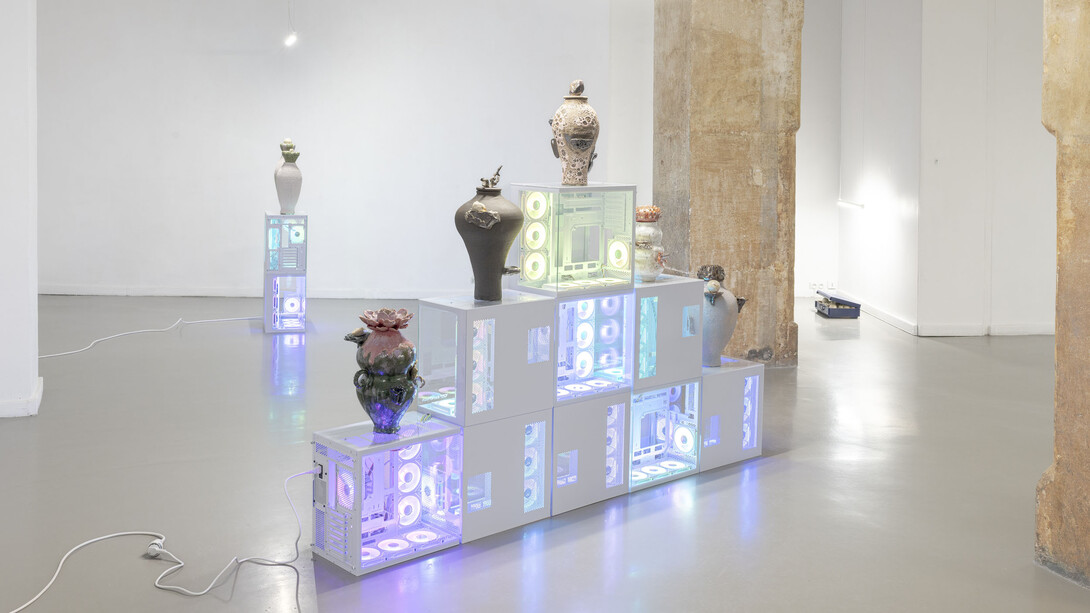
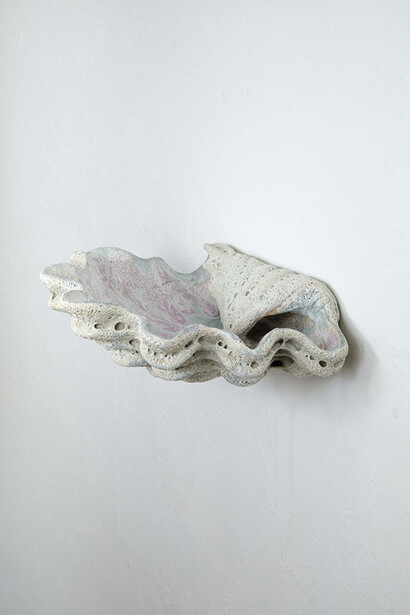
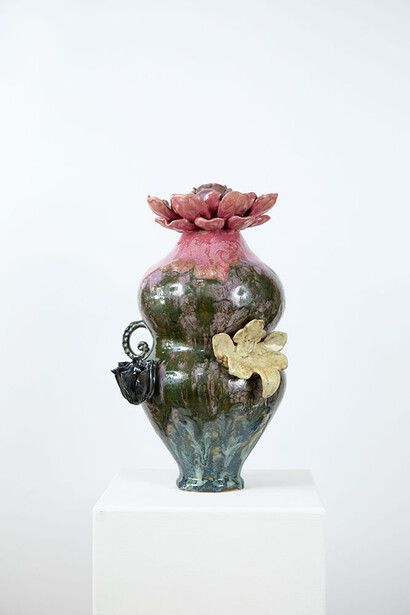
The project Shekel & Anubis Agency draws inspiration from Neil Gaiman’s American Gods, specifically from the fictional funeral home run by Mr. Jacquel (Anubis) and Mr. Ibis. In her new body of work, Arina Antonova reimagines contemporary funerary urns, reliquaries, and mourning vessels, not as sterile, industrially produced items, but as tactile, emotional, and customizable forms of radical care and transition.
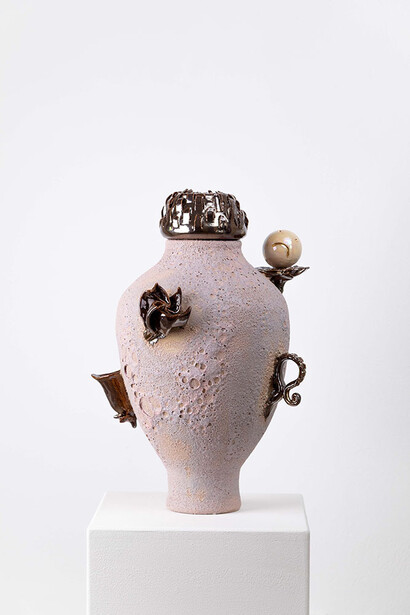
The series comprises six sculptural urns and a central fountain titled Fountain of lamentation. These urns are not merely containers for ashes; they are bodies themselves—interactive, decorable, and sensorial vessels meant to accompany the living in their grief rituals and the dead in their symbolic passage. One urn is conceived as a couple’s urn, allowing a shared resting place, and the fountain becomes a space for reflection, solace, and public remembrance.
Antonova’s practice centers on ceramics as a deeply corporeal medium. Here, she imagines a future where mourning practices are no longer dictated by capitalist, bureaucratic, or sanitized protocols. Instead, she opens a space for ritual invention, encouraging communities to reclaim death as a space of agency, tenderness, and even play. The artist proposes an aesthetic rupture from the neutral, impersonal design of current funerary culture: each of her forms carries emotive symbolism, references to food, flora, seashells, and everyday textures of care.
In a society where death is increasingly taboo and euthanasia remains heavily restricted or inaccessible in many countries, Antonova raises a provocative question: What if we could choose our own final resting form? What if our mourning objects were shaped by love and humor rather than administration?
The Shekel & Anubis Agency introduces a fictional but potent structure for post-mortem self-determination, proposing that care for the dead is inseparable from care for the living. Her glazed ceramic emojis—evoking feelings ranging from joy to sorrow—allow for a digital-age vocabulary of grief. These sculptural “emotions” can be attached to the urns or left at the fountain, offering a way to communicate with the departed or with one’s own mourning.
Far from proposing a return to tradition, Antonova invites us to invent gestures rooted in intimacy, quiet defiance, and the acceptance of death not as an end, but as a shift in presence. She does not seek to vanquish death, but to dwell beside it, to give it form, and to allow beauty to emerge from its shadow.

![Mary Cassatt, Fillette dans un fauteuil bleu [Enfant dans le salon bleu] (detail), 1878. Courtesy of Musée d’Orsay](/attachments/3ddcf3630b2e6b21d055a8488350d949784be8fa/store/fill/330/330/9b97dc5b17cad42577b6453f0968e961b1231ceb2b8b5ceb2c09057b2695/Mary-Cassatt-Fillette-dans-un-fauteuil-bleu-Enfant-dans-le-salon-bleu-detail-1878-Courtesy-of.jpg)