English
 Español
 Français
 Deutsch
 Italiano
 Português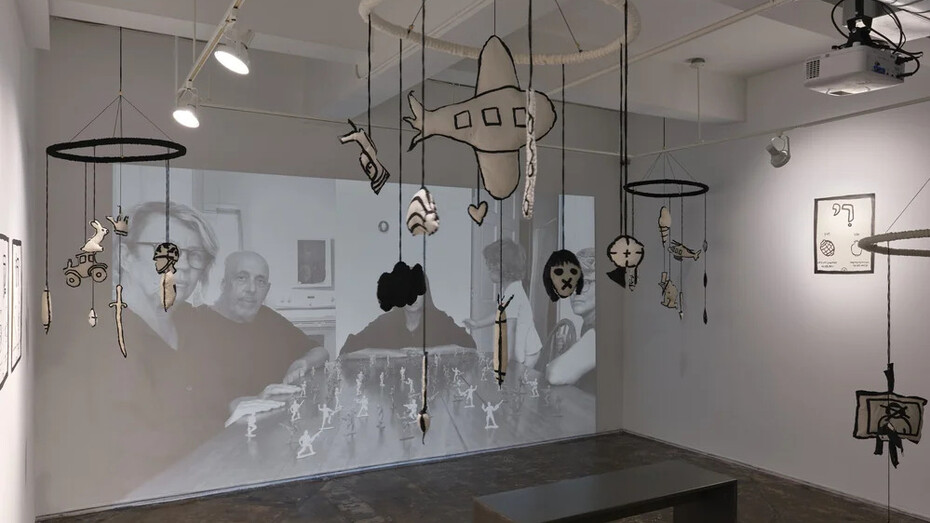
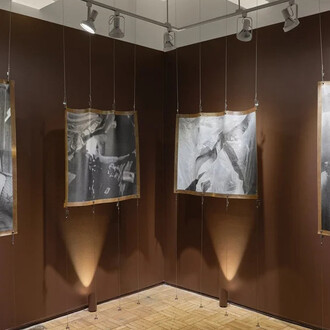
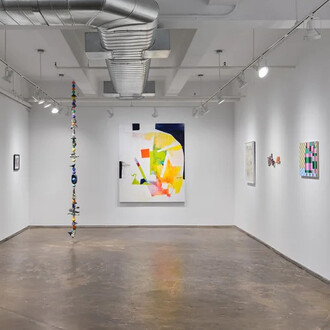
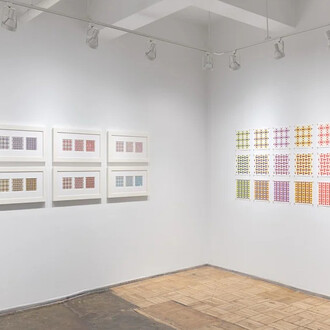
A.I.R. Gallery and The Neighborhood present P is for pomegranate, g is for grenade, and l is for love, an exhibition by multimedia artist Shasha Dothan. Dothan grounds the exhibition in her experience as the mother of a three-year-old, expanding the artist’s ongoing considerations of violence and desensitization. Across video, sculpture, and drawing, she examines how our understandings of nationhood, violence, and belonging take shape in childhood, often before they can be fully understood or questioned. Simultaneously, Dothan turns to the family as an intimate space where these terms are negotiated. Drawing from her upbringing in Israel—where military service and war remain deeply embedded in civic and cultural life, often framed as necessary and unavoidable—and her current experience raising a child in the United States, Dothan reckons with the interconnected impacts of violence and political instability in Israel, Palestine, the Middle East, and the United States, questioning how to ethically raise a child within conditions shaped by war and militarization.
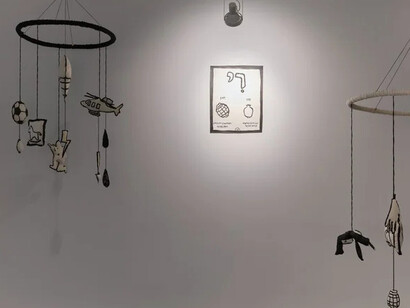
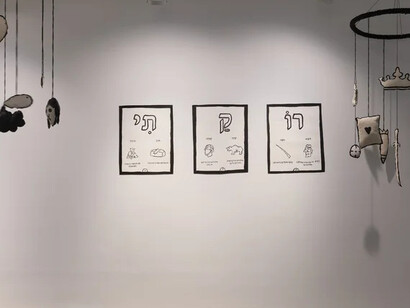
A series of pictographic drawings from a children’s dictionary lend inspiration for the exhibition’s title. One drawing depicts a pomegranate—an ancient symbol of fertility, abundance, and life—alongside a grenade, a weapon designed for destruction. Dothan has rendered both objects in the graphic style of a children’s picture book. Beneath each image appears its Hebrew name, revealing that the words for “grenade” and “pomegranate” are the same in Hebrew. This unsettling pairing points to the early formations of meaning and association, embedded not only in images but in language itself.
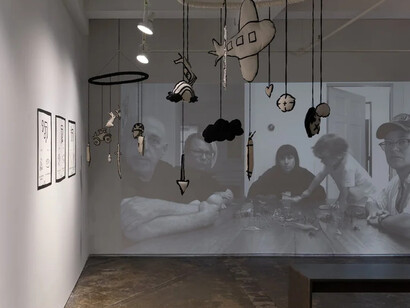
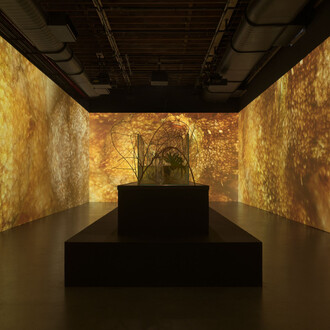
In the video War games (2025), Dothan’s young daughter crawls across a dinner table, tossing and jostling small toy army soldiers. Here, Dothan focuses on how objects of violence are normalized in childhood, where miniature guns, soldiers, and weapons are made accessible, desirable, and even playful. Dothan, her parents, and her wife sit around the table, all looking directly into the camera. The resulting multigenerational gaze holds regret, hope, and love in equal measure.
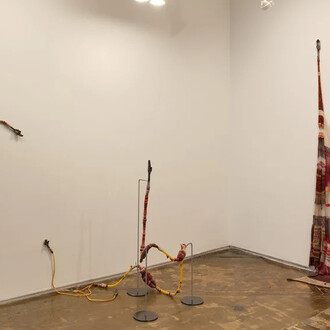
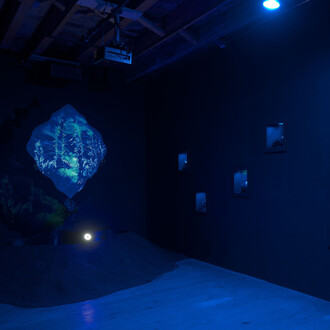
Central to the exhibition are hanging soft sculptures made using stuffed and painted fabric variously shaped into clouds, weapons, and airplanes. Stars shine, missiles soar, clouds spin, butterflies flutter, and bullets fly. Dothan suspends these objects as mobiles: the whimsical toys designed to soothe infants, transforming comfort and play into an uneasy reminder of a persistent culture of explicit and unquestioned militarization. What is meant to calm instead reveals the jarring imagery to which children are casually and regularly exposed.
In P is for pomegranate, g is for grenade, and l is for love, Dothan continues to turn inward, examining her role as a mother in response to the ways in which geopolitical structures render violence legible, acceptable, and even revered in childhood, alongside the corresponding challenges of parenthood. The exhibition also contains, however, the implicit—and insistent—possibility of resistance. Ultimately, Dothan’s work resists moral equivalence or easy reconciliation, instead insisting on a clear-eyed examination of how forms of violence become entangled with identity, belonging, and perception from an early age.
(The exhibition is curated by Landon Wilson)