English
 Español
 Français
 Deutsch
 Italiano
 Português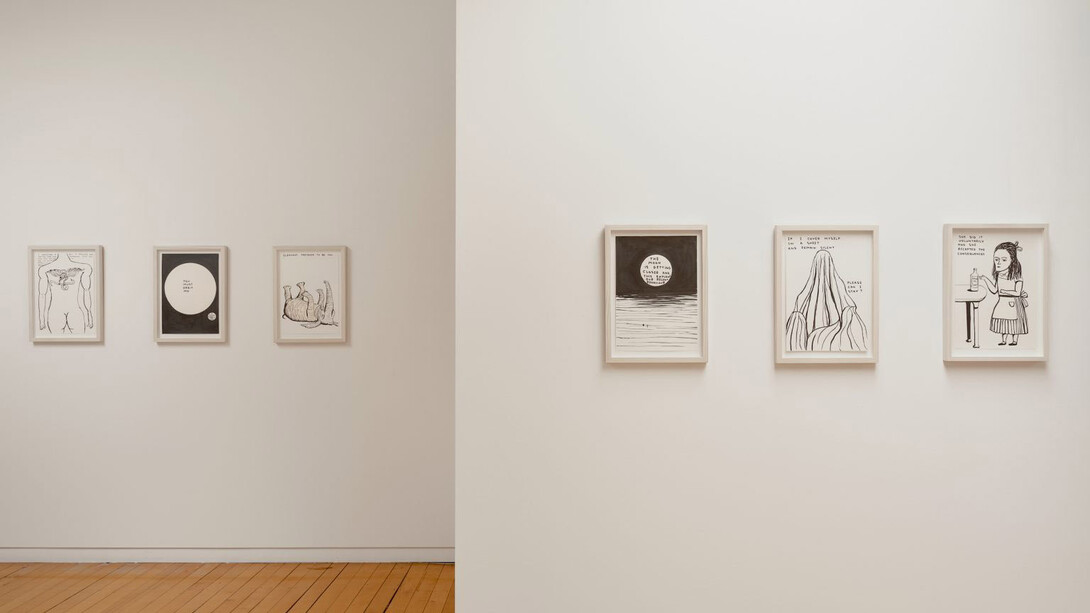
British artist David Shrigley (b. 1968 in Macclesfield, United Kingdom) is regarded as one of Britain’s funniest and most insightful conceptual artists and his darkly satirical art has won him an adoring international audience. He was a Turner Prize nominee in 2013 following his wildly popular, mid-career retrospective Brain Activity at the Hayward Gallery in London. In 2016 his monumental sculpture Really Good was unveiled as the Fourth Plinth Commision in Trafalgar Square, London. This sculpture of a hand making a thumbs-up gesture travelled to Melbourne in 2023 where it was included in the National Gallery of Victoria’s Triennial alongside Shrigley’s work Tennis Ball Exchange. His work has toured internationally – from 2015-18 the British-Council-organised exhibition Lose Your Mind travelled to six venues, including Power Station of Art in Shanghai, China; Storage by Hyundai Card in Seoul, Korea; and Instituto-Cultural-Cabanas in Guadalajara, Mexico. He was awarded the decoration of Officer of the Most Excellent Order of the British Empire in 2020.
Shrigley had his first exhibition in New Zealand in 2015 when he was Two Rooms’ artist in residence. During the residency, he set himself the challenging task of producing sixteen oil paintings in sixteen days. The resulting paintings had punchy, primary colour schemes and hovered between figuration and abstraction. Their wobbly, hand-drawn texts featured the words “It’s ok”,” good”, “very good” and “problem”, hinting at an underlying anxiety which contradicted the optimistic slashes, spirals and blocks of colour on the canvases. Like much of Shrigley’s art, these works referenced the banal details and conversational tics of everyday life and the existential angst of the human condition.
Although he tackles serious subjects, such as the United Kingdom’s 2016 decision to leave the European Union, which was the subject of his Fourth Plinth work Really Good, Shrigley’s art is always tempered by his wicked sense of humour and attunement to irony and absurdity. For example, in his exhibition Brain Activity at the Hayward Gallery in 2012, a taxidermied Jack Russell stood on its hind legs holding up a placard stating “I’m Dead”; a brass bell was accompanied by a sign which instructed “Not to be rung again until Jesus returns”; a drawing of a tombstone engraved with a shopping list begged the question: at the end of a life is that all there is?
Drawing forms the bedrock of Shrigley’s practice and his art has appeared in numerous broadsheet newspapers, books, magazines and galleries. He also works in sculpture, painting, animation and music, and his practice often involves collaboration and extends far beyond gallery walls. In 2017 he saw an article about an Oxfam shop in Swansea which had humourously installed some copies of Dan Brown’s novel The Da Vinci Code in its window with a sign pleading for no more donations of the book. This sparked Shrigley’s 2023 project Pulped Fiction in which he collected 6000 unwanted copies of Brown’s novel and then, using the pulped remains of this novel, produced a limited run of 1250 copies of George Orwell’s novel Nineteen Eighty-Four. Shrigley’s choice of Orwell’s prescient book warning about the dangers of totalitarian regimes can be read as more than just a coincidence.
In 2022 Shrigley entered into a playful collaboration with his audience when he made an installation titled Mayfair Tennis Ball Exchange. The walls of Stephen Friedman Gallery in London were lined with orderly rows of tennis balls installed on narrow wooden shelves and the artist invited gallery visitors to help themselves to the new balls and replace them with used ones. Through the course of the exhibition the pristine, green balls were replaced with scuffed and faded balls in different colours – many of them with zany, hand-drawn texts on them. As an astute commentator on the often overlooked quirks of contemporary life and an artist who makes us laugh and think and puzzle over our shared existence, Shrigley is an artist we can’t live without. At least for now we can choose to ignore the text on one of his works: “Tell me when I am no longer needed and I shall go”.
(Text by Virginia Were, 2025)