English
 Español
 Français
 Deutsch
 Italiano
 Português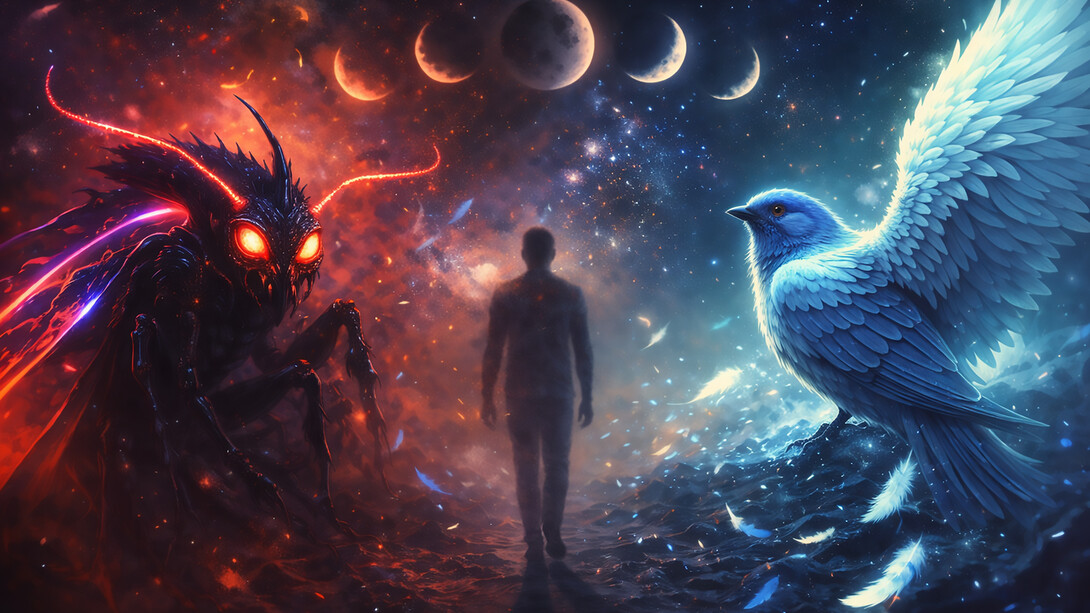
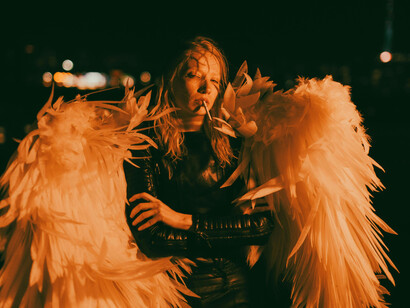
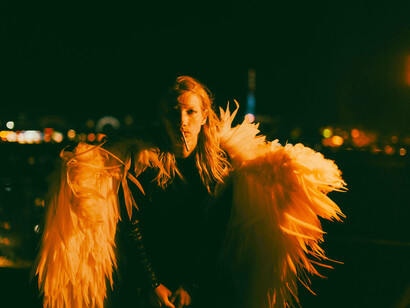
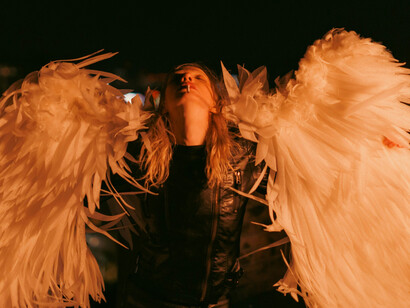
My love has metamorphosed into a giant insect, or a neon demon, and at times a bluebird a feathery angelic one [my analytical mind craves a word that rhymes with demon it while delivering a softer meaning]
I will keep it sacred through all of the moon phases, for the moon remains the same. Had always been the same moon for all humans too. It is the appearance, blue or red or full or faded, fallen off the sky almost. When you love a monstrous being, a fiend disguised as a friend, you grieve in layers, in otherworldly dimensions, with galaxies of stars sparkling in hope crumble into a supermassive black hole until you become a ghost yourself— what is eating us alive? Anxiety is one boring common denominator, boredom the other, and they multiply endlessly, birthing cravings of escapism from and into the mind so I lose the mind, toss it, observe it without judgement like I became a headless chicken, running. I have to leave the hive and start over lobotomized. But I only crave arthouse imagery, poetic depth, and sophistication to elevate myself from the depths of inadequacy, and the Dunning-Kruger effect no longer consoles me since I am living inside my own skewed perception: out of touch with my unfair and ruthless self-conception.
Images float in front of my eyes and we call it thinking, at times breathing in and out—reminiscence of the past with an unimaginable future, for your future is now stripped from you, a carpet pulled out under your feet so you walk on the walls the ceiling, and forget about gravity and its pull. Everything you gain is swallowed within this hole before you can feel complete, feel whole. You remember you are a half-formed being with all this experience highlighting all you lack in neon letters flashing, blinking faster than seconds, everything you add to the equation of life subtracting instead of adding, eliminating instead of choosing— hope is a feathery thing but even my neon demons have bare chicken skin— hope is the feathery light white thing I intend to birth to, in a messy place I inhabit, I am no bird and neither are you and that is why we need to stick.
“Hope” is the thing with feathers is one of Emily Dickinson’s famous lyric poem that I had alluded to in my poetic prose piece.
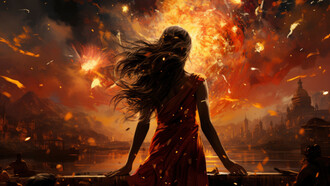
Neon Demon
A plump rich, bright apple all blood;
Bruised in my wavy
Blues inside dancing like fire—
Eyes plus heart equals an X-ray for everything faux.
I see your bipolar nature, a sentimental
Character built to deceive naive audiences
And targets—
In a world built within a screen, to drown the
Words of screams, all those times you escape from
All those places you escape in the pursuit of “what’s next”
And I find you leave parts of yourself, diminish into
A ghost, a blue barbed wire follows you around
Where you find yourself trapped in a prison-mind
A glass box, everywhere you float—
Your antidote is becoming a spiritual junkie;
Selling your Ferrari, your
Maserati before you get to own any—
Can’t help but think how they all rhyme with
Harakiri, Atari, memento mori.
On writing poetry inspired by the movie names, “Neon Demon, and “Die My Love”
After hearing a Huberman Lab podcast episode on creativity (featuring David Choe), I realized I feel compelled to ingest and transform every movie, scene, title, or line that provokes my creative urges—finding an outlet for what it wants to become through my perception and experience. I was scrolling through an artsy movie app on my projector, watching titles and cinematic scenes flash before my eyes—so many choices, so many worlds.
Coming across the movie title "Die My Love," I was struck by the dichotomy: the duality of violence and love, of an ending and something deemed eternal, even transcendent. The possessive phrase "my love" felt overused yet loaded with meaning. I couldn't settle on how to read this imperative sentence containing multitudes. Is the narrator addressing the emotion of love itself, or love in human form—a significant other? I lean toward the former; I have more power over my own love than I give myself credit for. Or I wish to believe so.
I wrote a stream-of-consciousness piece inspired by another film: "Neon Demon." The contrasting tension between those words provoked something in me. I transcribed the poem from my handwritten notebook, though as I write this introduction, I barely remember what I put down on paper almost a week ago. That's the magic of inspiration—it's a ghost that visits as she pleases and vanishes if we're ungrateful for her presence.
So I'm grateful, and I consider myself lucky that I captured words on paper before my unreliable memory could betray me, altering moments against my will (and sometimes according to my will in equally insidious ways). This is something our minds use as a protective mechanism, and I surrender to the ways my body attempts to protect me—just as I surrender to the ways I'm inspired through new mediums.