English
 Español
 Français
 Deutsch
 Italiano
 Português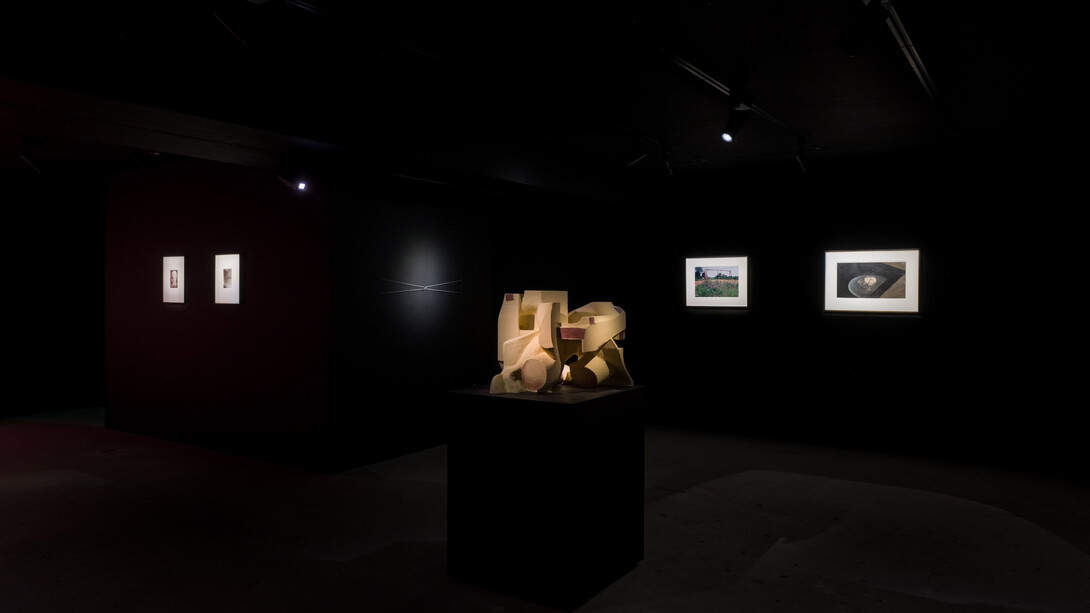
What is the fine line between undiagnosed paranoia and collective psychosis? Emmanuel Carrère’s 2005 film La moustache, adapted from his own 1986 novel of the same name, portrays Marc, a Parisian architect who decides to shave off his mustache before a party one night. To spiraling consequences, it turns out: for neither his friends, nor his coworkers, nor his wife acknowledge the difference, even denying that he ever had a mustache to begin with. When his wife threatens to send him to a psychiatric institution, Marc, in a moment of panic, makes an escape, boarding the next plane out of Paris to Hong Kong.
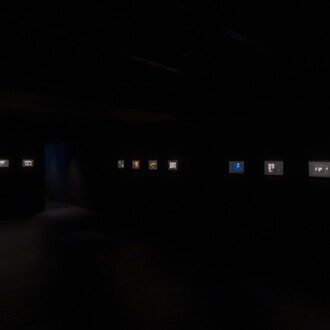
A reality without consensus, and the destabilizing effect an experience of it might prompt, is the subject of a formally attentive and hermeneutically provocative exhibition curated by Jordan Stein, a longtime fixture of Bay Area arts, at Hong Kong’s Empty Gallery. His riff on Carrère begins in a kind of foyer, where a trio of found-object works set the table for a negotiation between the dissemination and containment of uncomfortable knowledge. Ansel Adams’s grayscale photograph Mount Williamson, Sierra Nevada from Manzanar, 1944 is printed as an unofficial poster, its pile of stones underwritten not with a title, but with the placeholder text “Examples.” Together, the cryptic elements seem to displace historical events at Manzanar, California, site of a Japanese-American internment camp during World War II, with an industrially aestheticized view of nature – nothing to see here (Adams did photograph the “War Relocation Center” in 1943–44). Nearby, an installation by Doris Guo (b. 1992) presents a domestic event that, however illegible, still gestures vaguely towards a world outside: a flipped-over couch, topped by a pair of empty drinking glasses and a crumpled-up umbrella, the scuzzy bottom of a beer can projected on the wall. In a way, her Black hole (2025) is an obverse of Stephen Kaltenbach’s (b.1940) Inverted observer (1970–), a pinhole camera that projects its exterior into its own steel-cube body, denying its viewers what the artwork sees while framing them in the apparatus of observing the unknowable.
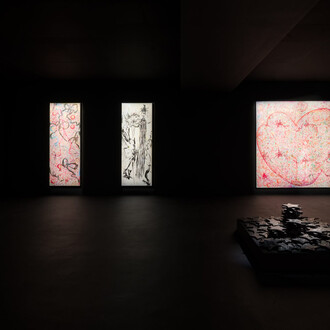
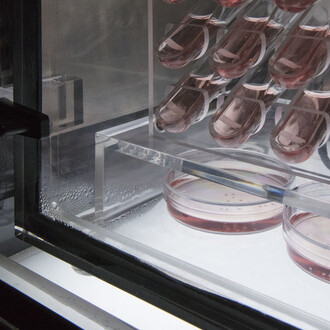
The main body of the show offers a survey of American Conceptual and Minimalist art that, even in miniature, is a rarity in Hong Kong. In its staging of abstraction as psychic suspicion, a paranoid reading might link the works’ formal properties to inflection points in the development of post-War American art and its categories of inclusion and exclusion, both abstract and material. Leo Valledor’s (1936–89) geometric composition A new slant (1981), in which plum and purple shapes cut across the canvas like psychedelic windows, appears as a foil to a lesser-known but existentially stunning graphite drawing by Lee Lozano (1930–99) – notorious for her twin decisions, in 1969, to withdraw from public art engagements and to “boycott women” – of two stacked triangular figures that might extend into infinity. Stein has also drawn from the personal collection of Barry Rosen, co-executor of Lozano’s estate, the marine-debris-studded shells of several carrier snails, probing whimsically at the accumulative effects of art’s collection and circulation over time.
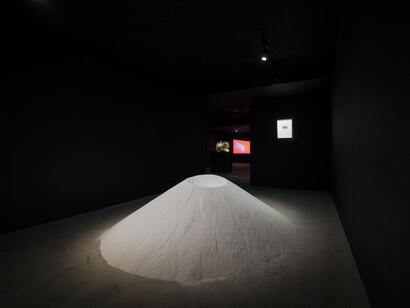
On the note of time: the breath-taking appearance of Paul Kos’s (1942) *Sand piece (1971) should prompt reflection on what is so often taken for granted in the invisible relationship between concept and the material cost of its realization. First created for a show at San Francisco’s Reese Palley Gallery – an important venue for Conceptualism housed in the VC Morris Gift Shop, Frank Lloyd Wright’s prototype for the Guggenheim Museum – Sand piece has only been exhibited a handful of times. Its installation requires drilling a tiny hole between two floors of a gallery, through which one ton of sand, piled in a volcanic cone, would trickle down in the span of twelve days, turning the gallery into an hourglass. The fine, kiln-dried grain specified by Kos gives the sand a pearly-gray chalkiness that, against Empty Gallery’s darkened interior, resembles uncannily black-and-white photos of the original. Seemingly impossible to view and document in its totality, the fractured experience of Sand piece underscores the exhibition’s wider sense of breakdown in collective knowing.
It is tempting to read in Carrère’s choice of Hong Kong, where we see Marc riding the Star Ferry back and forth across the harbor in increasing discombobulation, an obvious allegory of the city’s own tragic search for postcolonial democratic identity, trapped in that existential cliché between East and West. But in Stein’s formally driven transposition of Bay Area and post1960s American art, the kinetic relationship between center and periphery – whether geopolitically, in considering California as the land’s end of Manifest Destiny, the traversing of the Pacific as a site of proxy imaginations, and the role of Hong Kong at the periphery of Cold War imperialisms; or individually, as we shift uncomfortably between hegemonic and marginalized truths as the observer and the observed – would suggest a radical containment of all possible, even schizophrenic perspectives as one basis of a collective reality. If knowledge might lead to action, the discomfort of art is always available as plausible deniability.
(Text by Jaime Chu)