English
 Español
 Français
 Deutsch
 Italiano
 Português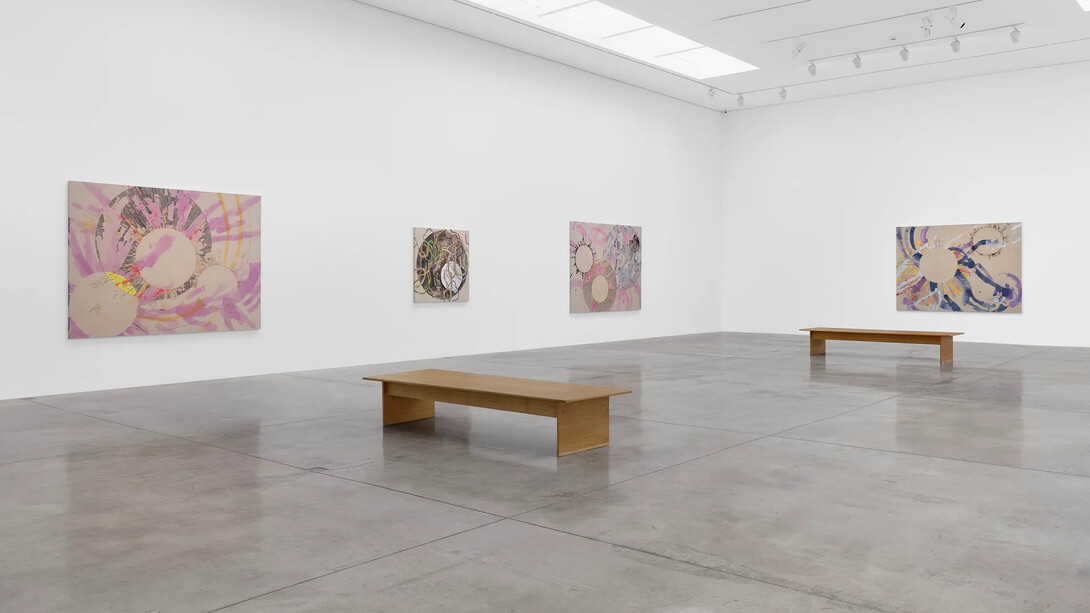
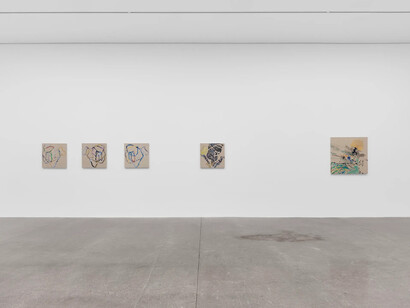
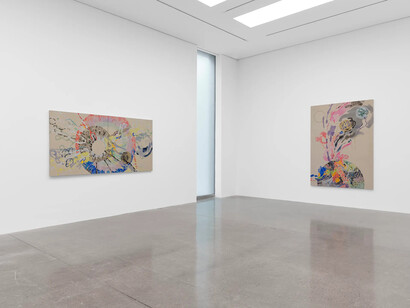
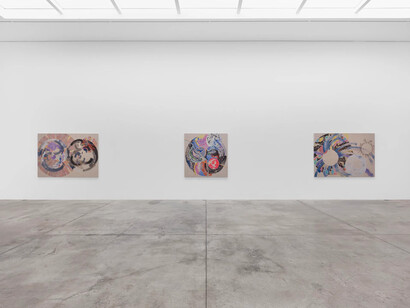
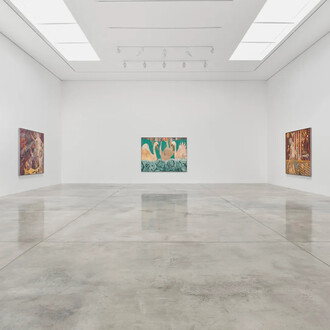
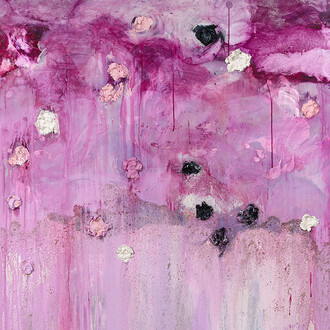
Known for her unique visual grammar, which sees gestural passages of paint brought into tension with embroidered thread, Jessica Rankin presents a new body of work that finds inspiration in the unity of creation and destruction. Across these compositions in her exhibition in the air / a memory, accumulations of paint and stitched lines evoke both cellular and cosmological scales of movement and connect the act of making within cycles of transformation, collapse and renewal. Drawing upon creation mythologies, as well as religious, poetic and literary texts, Rankin’s new work addresses moments of rupture, in which destruction is at once the very precondition for rebirth. The works and their titles reveal an archipelago of sources, among them the Miltonic paradox of ‘darkness visible’, which speaks to the heightened global, political and economic uncertainty of our times.
Colliding spherical forms recur throughout the exhibition and reflect Rankin’s preoccupation with the common structure and contents of creation myths, as one that often involves generative acts of violence. When sweet and bitter mingled together (E.E.) (2025), for example, references the Babylonian epic Enūma Eliš (c. 1200 BCE) in which the matter of creation is formed from the dismembered body of the primordial goddess, Tiamat. As in so many of Rankin’s works, the overlapping forms, materials and details of Rankin’s compositions encapsulate the binaries at work in these mythologies: male and female, earth and water, good and evil, life and death. Yet it is always left unclear as to whether the scene depicts a moment of creation or destruction – whether a Big Bang or an apocalypse. This ambiguity is central to Drink the liquid light (M) (2025), which references John Milton’s epic poem Paradise lost (1667). Works such as Weave it with black wings (JR) (2025), meanwhile, featuring an empty sphere emitting solar flares of jet black, is a visual exploration of the darkness of the present, but one that also allows for the discovery of a new light from within.
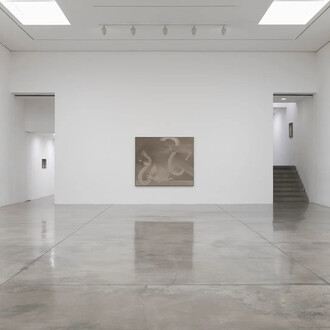
Seeking to capture the energy of transformation across vast timespans and scales, Rankin’s technique and imagery ‘feels both cellular and celestial at the same time’1. The exhibition title, ‘in the air / a memory’, immediately recalls a longstanding philosophical enquiry: why is there something, where there could otherwise be nothing? Replete with planet-like forms floating in abstract space, and silken passages evoking air, dust and cloud, certain works bear a resemblance to star charts or medieval cartography. Engaging Rankin’s interest in topography and map-making, such works prompt timely questions about the acquisition and control of territories, and the human drive towards lunar and interplanetary expansion. Artworks like When a snake was our mother (AN) and the Tracery glyph series (all 2025) make use of looping overlapping lines that resemble rivers or aquatic pathways viewed from above and conjure the primordial force of water as both a mothering substance and an agent of destruction. Formalizing Rankin’s attraction to patterns that can be found in the natural world, whereby a map of tidal flats can suddenly ‘look like vascular systems or images of brain activity’2, Rankin suggests an inherent parallel, if not inextricability, between humankind and the natural world.
The titles of Rankin’s artworks draw upon a deep repository of texts and consider, among other things, mythopoesis and the way in which both feeling and spiritual knowledge are carried by language. The artist’s work quotes widely – from the poetry of Alice Notley, Sylvia Plath, and the artist’s mother, Jennifer Rankin, to Yoruba praise poems and the ancient Egyptian book of the dead (c. 1550 BCE) – at times stitching the words and phrases at the edges of the canvas, a space where she finds that language could sit ‘far more comfortably – like the spine of a book’.3 Hived like honey (SP) (2025), for example, takes its title from Sylvia Plath’s poem Epitaph for fire and flower (1957), in which the poet reflects on love and passionate destruction. In this, Rankin’s choice of title points to a sense of creation and impermanence apparent in her composition, conjuring the golden ooze of honey and the knitted structure of the hive, at once fragile and resilient.
Continuing to interrogate the gendered histories of making, Rankin’s hybrid compositions stage a collision between fluid brushwork and the taut precision of stitched thread. Where paint has spilled beyond the edges of the frame, Rankin stitches lines of thread over the marked area, a final act that completes the work. This gesture of care can be figured as a form of repair, linking, perhaps, to mythological conceptions of the feminine as a creative and destructive force. Importantly, Rankin’s insistence on combining embroidery with painted gestures allows the artist ‘to poke holes in the idea of painting’, whilst ‘remaining critical of it, its history and what it pretends to be’.4 The feminist lineage of the artist’s stance is not only art historical but familial, with this new body of work returning to the longstanding influence of Rankin’s deceased poet mother, and an afterlife lived in words, whose writing ceaselessly inspires and informs the artist’s making.
Comprised of paintings that incorporate needlework and text, ‘in the air / a memory’ looks to creationist myth to meditate on the temporary quality of states and the coexistence of order with disorder: in selfhood and society, in art and creativity. Set against a backdrop of increasing social and political tension, these works serve as a reminder of the dual presence of harmony and chaos, optimism and despair: ‘a sense of things breaking apart as well as coming together’.5
Notes
1 Artist conversation, unpublished, December 2025.
2 Artist conversation, unpublished, December 2025.
3 ‘Jessica Rankin: ‘Sky Sound’ at White Cube Gallery, Hong Kong’, post-ism, 3 January 2025.
4 ‘Jessica Rankin on Embracing the Unfamiliar’, Ocula, 31 October 2024.
5 Artist conversation, unpublished, December 2025.