English
 Español
 Français
 Deutsch
 Italiano
 Português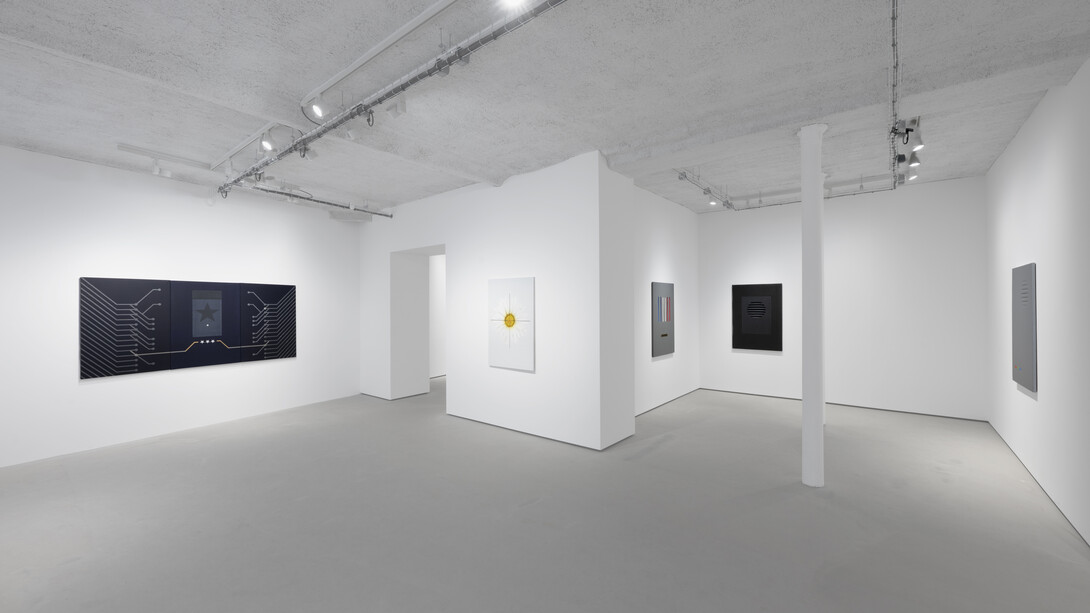
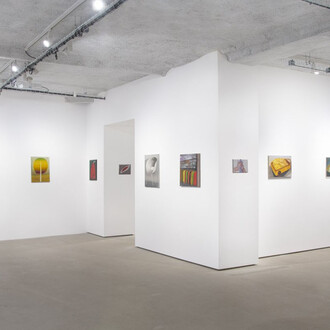
This first solo exhibition of Manuel Alvess (1939–2009) in France—and outside Portugal—reveals the previously unseen and fascinating work of a little-known artist who produced his entire body of work in Paris, where he lived from 1963 until his death in 2009. For this inaugural presentation, Galerie Jocelyn Wolff has selected a group of paintings that have never been exhibited and had never left the artist’s studio.
The work of the Portuguese artist Manuel Alvess was discovered very late, in 2005. Alvess pursued his practice on the margins of the art world, outside both the market and institutional networks, without being antisocial or cut off from the world. He worked to earn a living, briefly took part in the Parisian effervescence of the 1960s and 1970s, then withdrew, developing a practice at a distance from the art milieu while keeping contemporary creation under close watch—under surveillance. It was thanks to Lourdes Castro, who organized a visit to his Paris apartment by curators João Fernandes and Sandra Guimarães, that the Portuguese artist emerged from anonymity. In 2008, the Serralves Museum conceived an exhibition of Manuel Alvess built around a corpus of works centered on measurement and language, postal works, and performances, situating the artist within the context of a young Parisian and international conceptual avant-garde. The choice of paintings focusing on themes of administration and bureaucracy also pointed in this direction.
Manuel Alvess’ painting, as it presents itself to us today, leaves a mark with striking force. Its acuity surprises us. This is due to a visual language of disarming simplicity: a graphic style and pared-down iconography. Very often, one has the impression that the painting is looking at us, keeping an eye on us, in a way that is mocking, ironic, or threatening. This is the case with the works selected for the exhibition, whose title Haute Surveillance (High Surveillance) reprises that of two large triptychs. Without claiming to summarize the entire body of work, the exhibition draws out a thematic thread that runs through it from the beginning. This theme is already implicit in the “administrative landscapes” produced in the 1960s and 1970s, which addressed the absurdity of a Kafkaesque bureaucracy— particularly that of the Salazar dictatorship under which Alvess lived.
A conceptual painting
If Alvess’ late discovery lends his work a particular appeal, it is first and foremost its conceptual and visual qualities that move us today. A quasi-metric rigor in both form and detail gives each painting, each work, a unique intensity, which also stems from a distinctive feature of his art and personality: an unfailing sense of humor—sometimes discreet, but always active—that reflects the sensibility of a man of his time.
Spanning four decades, his practice encompasses painting, performance, objects, drawing, and mail art. Painting constitutes an essential part of this practice through its coherence and persistence ; it accompanied him throughout his life and served as the most faithful repository of a reflective aesthetic. The painting is a speculative space in which the painter puts painting itself to the test, in close dialogue with contemporary art and over the long term. In the 1960s, he was in tune with the avant-gardes—conceptual art, performance, and mail art—which led him to participate in major events in Paris and in the São Paulo Biennial. Later, his work took on a semiological turn that aligns it with some of his contemporaries, such as Edward Ruscha or Jack Goldstein, or with pop and post-conceptual tendencies like appropriation art in the 1980s, particularly in its American form, sharing with them procedures of appropriation and decontextualization of signs and words.
Alvess, too, embraced a visual culture ranging “from Goya to Chantal Goya” (sic), clearly drawing on advertising—a field he knew well, having worked for twenty years as an art director in an advertising agency. In a sense, he responds to it logo against logo, sign against sign, symbol against symbol. The painting presents itself as an echo chamber of everyday reality, of an environment shaped by advertising, media, and technology, from which it captures signs, objects, and themes, filtered through an effective semiology.
His painting engages a whole constellation of fundamental questions: representation, the subject in painting, the image, the sign. Reflective and literalist, heir to modernism, it takes into account its own components: the materiality of the support and the painting-as-object. In the 1960s and 1970s, he pierced the canvas with holes, slashed it, adapting Fontana’s gesture, adding objects—a rod, a zipper, rivets.
Above all, his painting is conceptual: each canvas works through an idea until it reaches its purest form. Without an idea, there is no painting. The idea triggers the painting and is its driving force. It is long contemplated and premeditated until the visual form perfectly coincides with the idea. This coincidence relies on precision and artisanal meticulousness in execution. Alvess is both a conceptual artist and a craftsman.
He chisels his form-signs like emblems ; their visual economy gives them a unique character, an intact freshness, and a consistently contemporary impact.
His works function like aphorisms: short, incisive forms that assemble few visual elements in search of the simplest possible composition. The artist favored concision ; he recorded thoughts, original aphorisms, quotations, or sometimes just one or two words in notebooks. A reader of philosophy, Alvess defined himself as “a painter who philosophizes, not a philosopher who paints.” Finally, his painting appears, in retrospect, as a programmatic enterprise, notably through the adoption of a single format (116 x 81 cm), chosen also for practical reasons, allowing him to store all his works in his tiny apartment, which he specifically arranged for this purpose.
A way of life
The artist produced relatively little: around fifty paintings, some twenty objects, a hundred drawings, not counting the mail art. Why did he not produce more works, particularly paintings? No doubt he did not wish to repeat himself or allow his art to become a formula. Once found, the form-idea suffices unto itself. Why repeat it?
Marked by the seal of uniqueness, his art rests on an ascetic economy of production that manifests a fierce independence. Without grand statements, it offers a concrete, albeit solitary, resistance to the commodification of art and to all forms of seriality. This ascetic regime corresponds to a way of living: life and art are intimately linked, governed by the same attention to detail, visible in his carefully composed appearance—Borsalino hat, blazer, waistcoat, white trousers in summer. He adopted a fixed outfit once and for all, tailoring the costume of an ironic character with slightly old-fashioned elegance. He embodied the true Baudelairean dandy—flâneur, aesthete, and ascetic—devoted body and soul to form, to an ideal: “I think it’s a luxury I still pay for: living alone, daubing paint, all that,” he liked to say. Several self-portraits showing him in his chosen city, Paris, testify to his desire for posterity, for leaving a concrete trace of his existence.
The exhibition
The title High surveillance reprises that of two large triptychs. Without claiming to summarize the entire body of work, it draws out a thematic thread that has run through it from the beginning. This theme is already implicit in the “administrative landscapes,” as the artist called them, which addressed the absurdity of all bureaucracy, particularly that of the Salazar dictatorship. Created in the 1960s and 1970s, these works are set against a white background, taking the A4 sheet as a reference. They reproduce characteristic elements of administrative activity—and even gestures—transforming them into relentless concrete abstractions: form and idea, composition and meaning coincide.
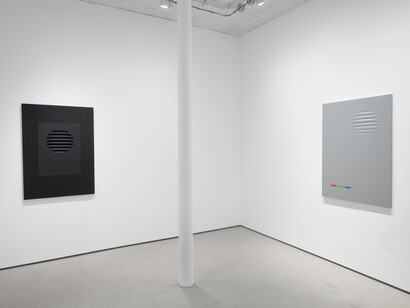
In addition to the two triptychs, three paintings convey a sense of threat that permeates the entire canvas and literally constitutes its background—very dark, black, midnight blue, or anthracite gray. In Alarm, hygiaphone, television (2001, 2002, 2002), the full-frame object coincides with the canvas itself.
These paintings reveal an essential feature of Alvess’s art: literalness, through which the referent or purified object becomes a sign, the ultimate operation being the coincidence between the form of the sign-object and the painting. These are objects of technical modernity, of a surveillance that infiltrates our ways of life and our most intimate gestures. The painting materializes a robotic power: a grille-mouth through which the abstract voice of authority passes. The artist captured the emblematic objects of a society he watched transform itself while traversing the city that this true Parisian flâneur walked every day.
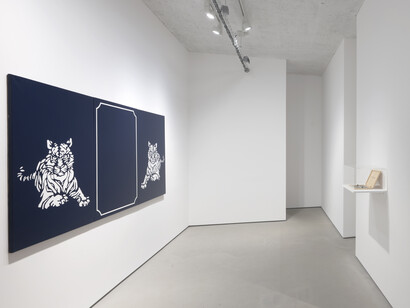
The triptychs Haute surveillance 1 (High surveillance 1) and Haute surveillance 2 (High surveillance 2) are undated, but their iconography links them to the three paintings from the 2000s mentioned above. Thus, a subject and its plastic treatment form a series, as was the case with administrative activity, bearing witness to the artist’s sensitivity to contemporary reality, and more specifically to systems of categorization, representation, and communication. The paintings from 2001 and 2002 reflect a post–September 11, 2001 context, in which security became a central theme of U.S. and international politics, and gradually one of the core concerns of Western democracies. The two triptychs, black or deep midnight blue, symbolically evoke a morbid atmosphere of surveillance. Monumental, they recall medieval or Renaissance altarpieces built around a central panel.
In one, the center is outlined by a white border that underscores its ominous power ; on the two side panels, two tigers, rendered in the synthetic graphic style of advertising logos, scrutinize us imperiously. In the other, a golden star extends into a network of lines that may evoke various things: a computer chip, a functional diagram, centralized, totalitarian... Alvess’ paintings function as allegories.
The Fusil à lunette (Sniper rifle) interprets the theme of security through a striking image, a biting emblem or rebus. A daisy is taken in the crosshairs, identifiable by its four characteristic marks. Daisy + rifle = “the flower in the gun barrel”: the iconography seems to literally reprise an expression dating back to the First World War, though its origin is now largely forgotten. In its absurdity, the subject composes a vanitas, highlighting the disparity between a flower that simply exists and the derisory cruelty of the gesture. Elliptical, Alvess’ works belong to the realm of the witticism—always disruptive—a short circuit between several heterogeneous elements.
Alvess introduced himself
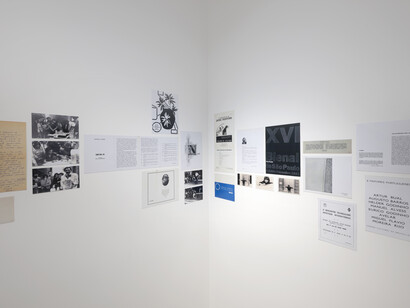
His children found several letters in his archives addressed to gallery owners, without knowing whether they were ever sent to their respective recipients: Marian Goodman, Yvon Lambert, Daniel Templon. The artist had a keen eye! He also wrote a short text in the form of a self-interview and recorded his aphoristic or scattered thoughts in small notebooks. Concision defines his style, which naturally expresses itself through a humor that is sometimes biting.
By way of introduction, it seems appropriate to let his spirit, his voice, be heard in his own words; this is why we reproduce a letter in which he presents himself and humorously stages a dialogue with Yvon Lambert, and through it, his relationship to art and to a milieu whose codes run counter to his vision of art.painting as a mission, as a debt to be paid, and I see no creditor for my debt.
My dear Master,
My first vocation was writing. But its descriptive aspect bored me. Poetry came next—it was better ; I could set words down and felt that they lived on their own. Painting, just after that, allowed me everything, and I became a painter at twenty-two. Since then, painting has become the main provider of meaning in my life.
I arrived in Paris in 1964, and from 1966 to 1971 I took part in the Salons de la Jeune Peinture, Mai, the Paris Biennials, interventions here and there, and a few other international events. Since then, having found no favorable wind, I have remained ‘at the dock’ and I have worked. (My ‘cellar’ today contains a good hundred things known only to those close to me.)
As galleries are not particularly sympathetic to me, I only showed three or four things to Yvon Lambert—it is not easy when one has, like you, work in constant availability.
I listen to you again... ‘For a young painter today, the first step is above all to do good work. If you do good work and you are in the middle of the desert, they will come looking for you with a machine gun even if your door is closed, because it is not by running after galleries or befriending this or that person, etc., etc., that...’
I listen further... ‘...it must be said that between the period when I was very well known and the one when I was less so, my work, thank God, encountered individuals who became attached to it because it had something endearing, and who, by their position and their person, had a relationship with that work and sooner or later gave it the dimension that was within it...’
Does one make it known that one is doing ‘good work’?
That is more or less the great question I ask myself. I am fifty years old and I see myself more and more without outward signs of existence.
That is more or less the great question I ask myself. I am fifty years old and I see myself more and more without outward signs of existence. I have the impression of having lived painting as a mission, as a debt to be paid, and I see no creditor for my debt.
I ask myself many questions, about painting and about myself. They will not come looking for me with a machine gun. In the meantime, I work... I follow your advice. Do you have any others?
I have told you everything, and I would very much like to see you one day. In the meantime, I am glad to have written to you.
Believe in my highest esteem."
(Manuel Alvess)
(Text by Anne Bonnin)
![Mary Cassatt, Fillette dans un fauteuil bleu [Enfant dans le salon bleu] (detail), 1878. Courtesy of Musée d’Orsay](/attachments/3ddcf3630b2e6b21d055a8488350d949784be8fa/store/fill/330/330/9b97dc5b17cad42577b6453f0968e961b1231ceb2b8b5ceb2c09057b2695/Mary-Cassatt-Fillette-dans-un-fauteuil-bleu-Enfant-dans-le-salon-bleu-detail-1878-Courtesy-of.jpg)