English
 Español
 Français
 Deutsch
 Italiano
 Português
What is recounted is not an adventure but incidents: we must take the word in a slight, as modest, a sense as possible. The incident – already much weaker than the accident (but perhaps more disturbing) – is simply what falls gently, like a leaf, on life’s carpet; it is that faint, fugitive crease given to the fabric of days; it is what can be just barely noted: a kind of notation degree zero, precisely what is needed to be able to write something.
(Roland Barthes, via Marta Fontolan)
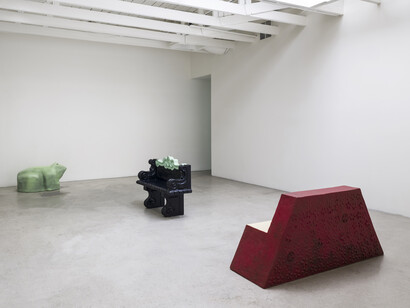
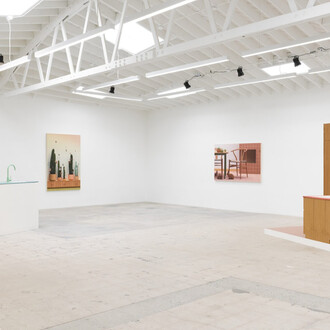
These are the most Hollywood of my benches. This time the thing I was telling myself is that I was reconstructing, in retrospect, but also all at once, the last five years. Since 2015, all of the benches, produced one per year, have been scaled versions of existing benches or quasi architectures in civic or commercial space. I often used the word tether to describe the benches. They are tethers to ongoingness or tethers to specific places and times. The place itself isn’t so important, although it’s not not important. It’s more the flash of a concrete elsewhere, in a memory or as a projection; an incongruity that produces a heightened state of vigilance.
So when I’m saying that the Hark benches are the most Hollywood, it’s partially obvious. I would point out the difference between my initial idea of the benches being a forensic recreation and my ambition being mostly this literal, spiritual tether-ness. Here it’s something else.
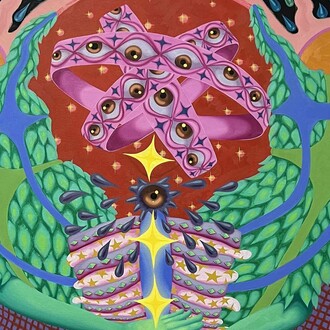
The main preoccupation I have for this show is an angel that visited me when I was here last February. It happened or it was so tangible of a hallucination that it may as well have happened. I was sitting on this concrete bench that Austin built into the back of our house. And then there was this crazy, shimmery, blue light. And it was an Angel. It was also somehow Jack in the Beanstalk and also somehow Lisa Frank. The presence was overwhelming even though it only lasted maybe an hour. The message (which was only an energy, no actual words) was a momentum forward and the idea of “nothing missing.”