English
 Español
 Français
 Deutsch
 Italiano
 Português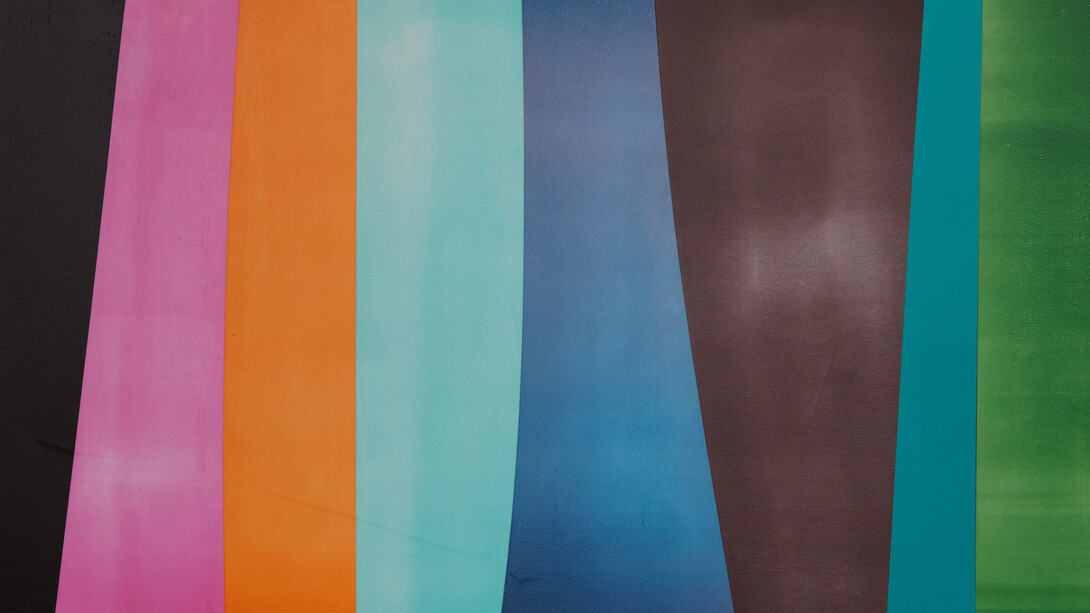
Marking twenty-five years of painting, Time travel follows the artist’s creative journey through works that illuminate his playful and perceptive engagement with color, line, and space, and their ability to convey a sense of movement and momentum. An Ohio native, Johnson moved west for graduate school, soaking up the offerings of the Los Angeles area, where he settled. His paintings synthesize his experience of Southern California’s natural and urban landscapes, architecture, lifestyle—he is an avid cyclist— and the region’s exciting history of influential visual art movements. In a recent interview with Ed Schad, Curator at The Broad in Los Angeles, Johnson reflects, “Sometimes my paintings are like abstract places informed by personal experiences. Layers of color may allude to my view of the San Gabriel Mountains bathed in magenta light at sunrise, and aerodynamic shapes in a composition may suggest my peripheral perspective during a bicycle ride.”
Johnson’s decision to relocate was shaped by a serendipitous encounter when, as he was considering graduate school, gallerist Rebecca Ibel introduced him to art critic and author Dave Hickey. Hickey suggested Claremont Graduate University for Johnson’s studies, showing him a catalog of work by sculptor-turned-abstract painter Roland Reiss, with whom he would study and whom Hickey felt would give Johnson the freedom to paint what he wanted. This advice resonated with Johnson, particularly the location. A year earlier, during the Yale Norfolk Summer School of Music and Art, Johnson had met artists from around the world and visited New York City for the first time. He determined then that he wanted to establish himself in one of the nation’s cultural centers of New York City or Los Angeles.
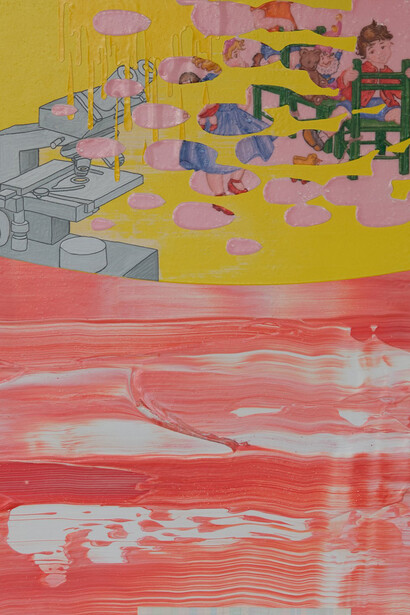
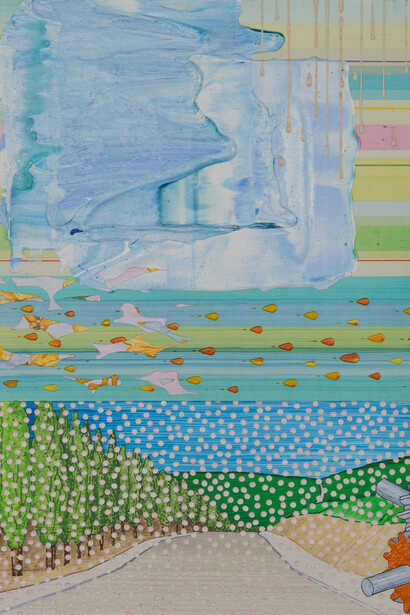
Johnson recently reflected that being at Claremont shaped his knowledge of “where and how to view art in Los Angeles, with an understanding of how Southern California art was unique in its histories of Light and space, Hard-edge painting, and an overall vibrancy and quirkiness.” Working within this context might have been daunting for some, but it motivated Johnson to discover his own understanding of what painting could be. His painting Hovering above (2000), completed during his graduate studies, offers an insightful introduction to a body of work from the early 2000s distinguished by its novel and surprising treatment of paint. In these works, Johnson revels in the surface, using transparency and texture to alter the perception of color and highlight the paint’s physicality. Viscous, waxy material is daubed, swirled, and pulled across canvas and paper, at times oozing over the surface before being sharply arrested by a hard edge and a smooth field. Alongside this playful investigation, Johnson explores the intersection of abstraction and representation through linear, diagrammatic-like imagery that overlays or emerges from the painted abstractions.
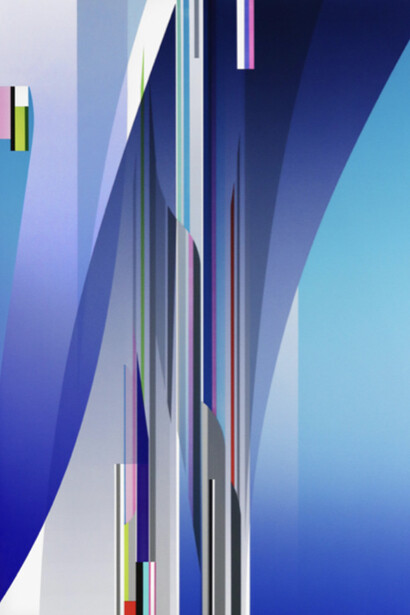
With Johnson’s ongoing exploration, his interests shifted away from tactile and gestural marks toward smooth areas that felt atmospheric and held light. Trading his brushes for drywall knives, kitchen spatulas, and spray guns, Johnson describes the effects of his process: “Spreading translucent glaze colors with large straight-edge knives can create a fluctuation of color intensity that seems like a luminous or reflective light source. And layering and weaving spray-applied colors with other smooth surfaces create rich spaces to explore.” Squeeze (2008) is a key example of his new focus. In this painting, he fully embraces abstraction, omitting representational imagery to allow an unobstructed view of adjacent fields of color that form subtle arcs where they press against one another. Johnson uses formal elements to generate multisensory experiences, such as the sensation of pressure in Squeeze. In Dazzle (2024), falling veils of sunset hues end in waves of ascending curves, while tapered ribbons of muted crimson, darkened to near black at their rounded ends, seem to be slowly pulled by gravity. By evoking sensory perceptions of fundamental forces like gravity, momentum, acceleration, and speed, and by harnessing color’s power to amplify energy and reflect mood, the viewer becomes an active participant in Johnson’s paintings.