English
 Español
 Français
 Deutsch
 Italiano
 Português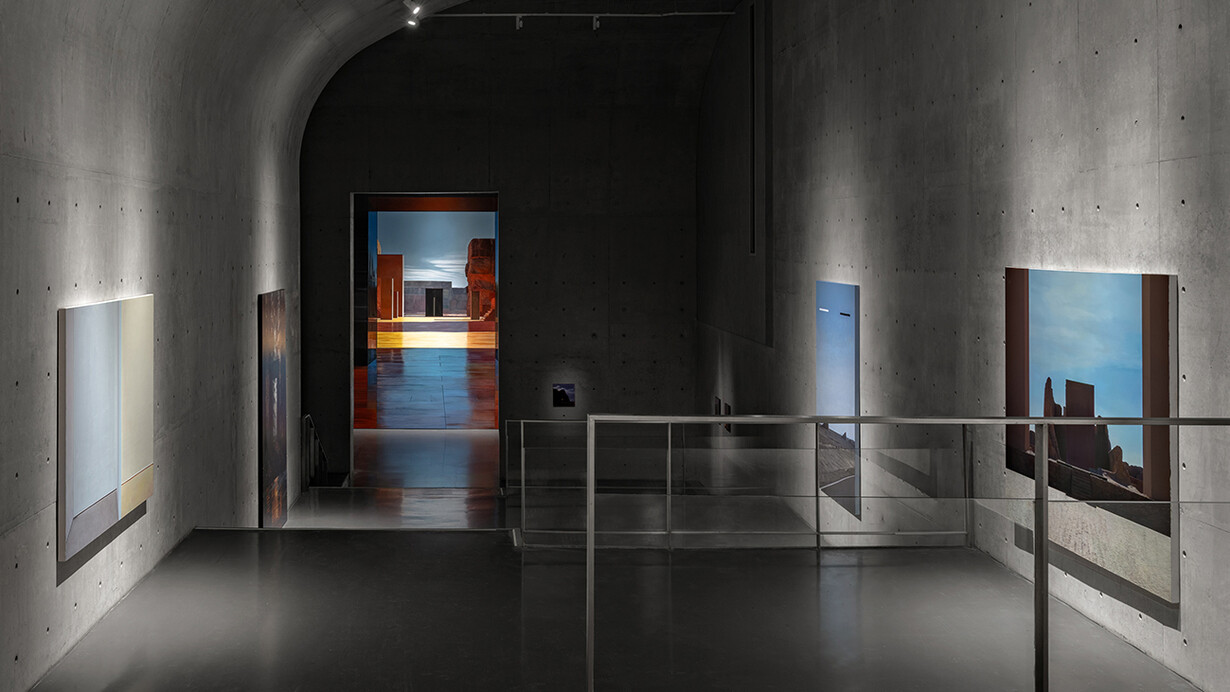
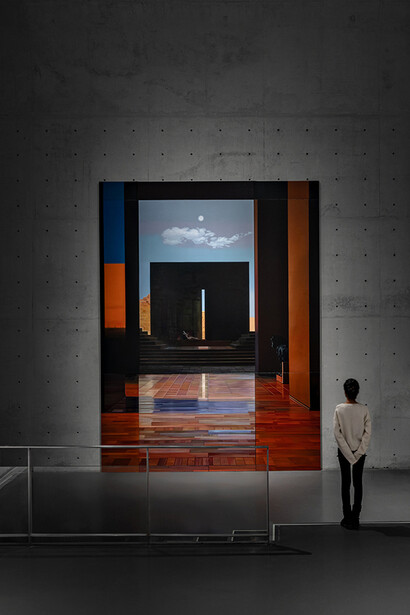
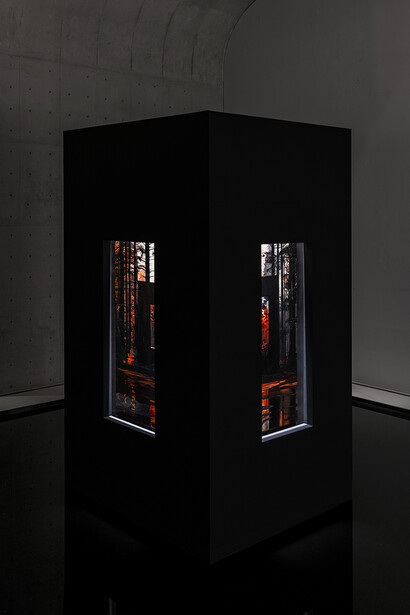
The exhibition begins with a narrow doorway—a threshold that appears and circles like black and white eagles, gliding from one room to the next. In Yang Bodu’s paintings, this doorway sometimes takes the form of a slender shaft of light, sometimes a spacious portico, and at times it hides inside a box—waiting to be discovered.
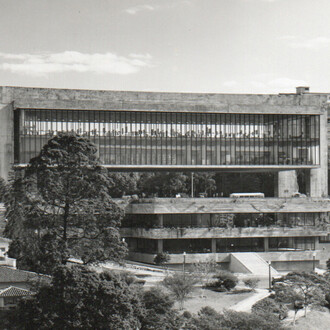
The narrow doorway opens onto Yang’s life journey: from her home in Philadelphia to the stillness of the museum; from the final years spent with her father to the ancient landscapes she later came to contemplate. This doorway transforms—moving from figuration to abstraction, from form to spirit, from confinement to redemption.
Over the past decade, Yang’s work has shifted from richly detailed realist interiors to an exploration of emptiness itself, where space becomes a vessel of perception. The layered walls, the subtle turns of corners, and the gradual compression of space into a single line of light—all culminate in the image of the narrow doorway. In this process, her gaze turns outward: from the architecture of interiors to the expanses of landscape. Ancient rocks, caves, and fjords emerge from her canvases, guiding viewers toward a vast and timeless realm.
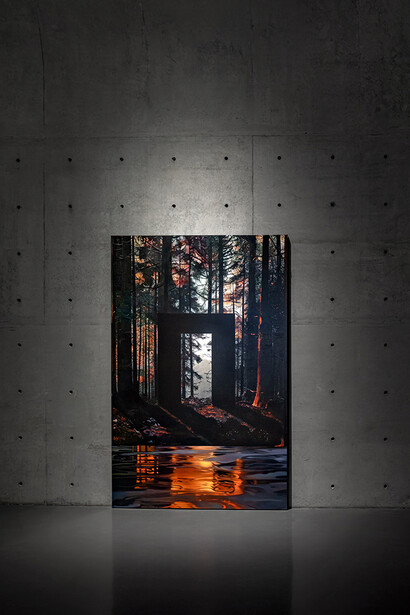
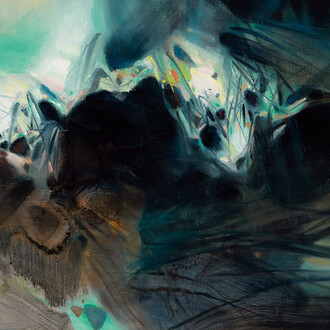
Yang favors the gloom of night over the brightness of day, sensing that the world holds far more than what meets the eye. In her landscapes, skies and seas draw viewers into a poetic, almost dreamlike realm. Yet these dramatic, mysterious settings are never the main story. Nestled among twilight mountains and bays is a small, meditative cave, perched halfway up the slope, serving as the heart of the painting. Amid shifting clouds and stormy skies, the cave shields against nature’s dark theatrics—like the nest of a black and white eagle—offering Yang courage, strength, and serenity in the face of passing time and darkness.
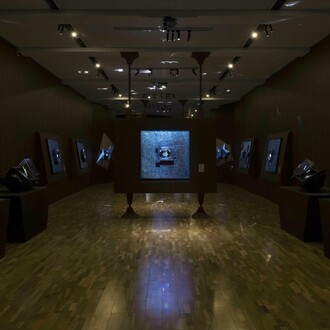
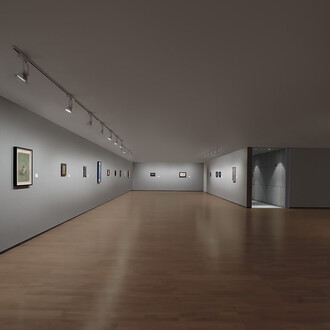
Beyond the cave, the pond becomes the exhibition’s most significant motif. Along the descending path, Yang creates a deep, cool, and contemplative world, centered on a modest pond, an island with architectural qualities, and dozens of surrounding paintings. As one moves through the space, the works subtly transform: reality and memory intertwine, images merge with their reflections, and distant views shift to intimate close-ups. Time and space seem to dissolve, drawing viewers again and again into a dreamlike labyrinth of consciousness.
Perhaps there is a more poetic way to read it: each painting mirrors the one before it, like a reflection rippling through dark waters, as if you are seeing yourself in the pond. On the central island, the circular passage of day and night unfolds—here there is no direction, no north or south, only a hazy, shifting glow. Drifting without support, it cannot be fully grasped, yet it brings an inexplicable sense of calm and quietude.
In Yang’s favorite film series, The lord of the rings, the worlds of demons, gods, and humans coexist. Similarly, her own work spans multiple times and spaces: the Philadelphia Museum of Art in the 20th century, the ancient ruins of Gaochang thousands of years ago, and forests, mountains, and bays far older than human history. Together, they create a strange and wondrous fusion of natural landscapes and the journey of life.
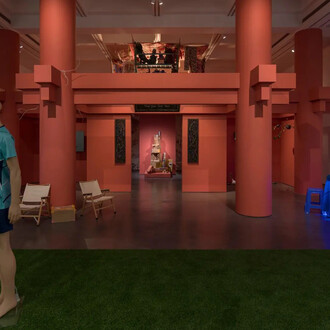
Yang has an enigmatic passion for space, enjoying both the creation of architectural elements within exhibitions and the making of architectural models. Her work is never isolated; painting, display, space, and architecture are all treated as a unified whole.
The exhibition concludes with a miniature wooden box, echoing the narrow doorway that opens the show. Each layer of the box contains two or three hidden compartments, inlaid with grand landscapes reminiscent of the gallery paintings but scaled down—like a portable, miniature “exhibition,” or an intimate inner chamber belonging solely to Yang.
Within this undulating, winding space, Yang unfolds a story of seeing, remembering, searching, escaping, and rebirth. The space itself becomes a condition of life, conveying emotion through a poetic, expressive language: the deeper the pond, the greater its power. It evokes the scene in The Lord of the Rings before the arrival of the two great eagles—“The sun burned red, and under the wings of the Nazgûl, shadows of death hung heavy over the land. Aragorn stood beneath his banner, silent and stern, lost in thought, recalling long-forgotten times or distant places, yet his eyes shone like stars, growing brighter as the night deepened.”