English
 Español
 Français
 Deutsch
 Italiano
 Português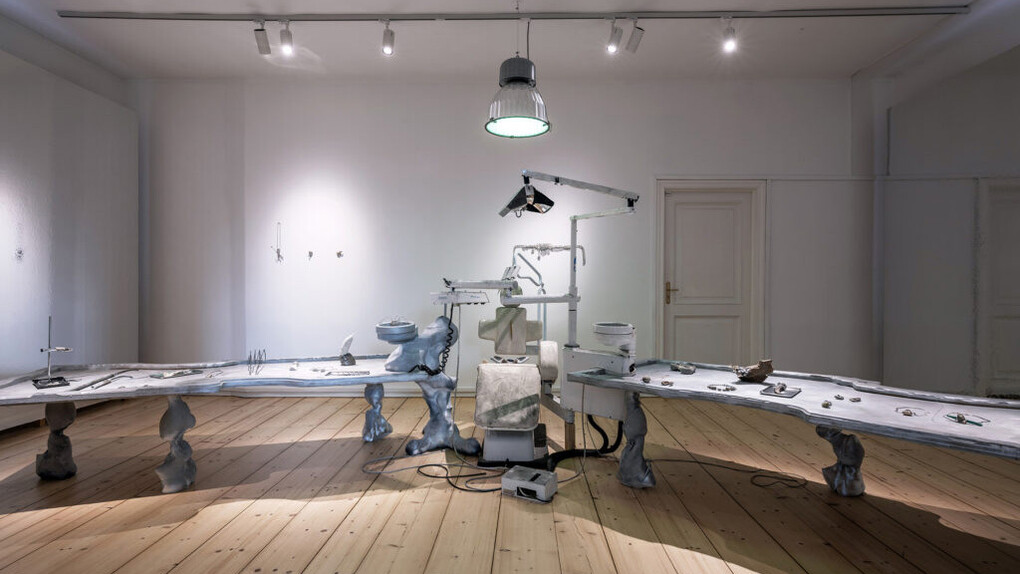
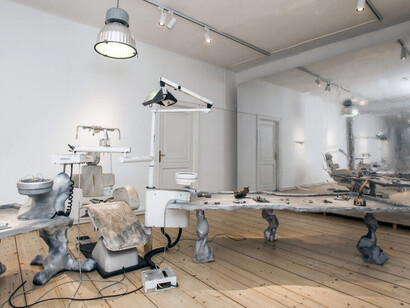
Neanderthal beauty clinic is a gallery exhibition that presents a speculative beauty installation created by Madlen Hirtentreu and Darja Popolitova, through which the artists reflect on how beauty procedures have become consumable quick commodities, revealing how activities marketed as self-care can conceal mechanisms of bodily control and subjugation.
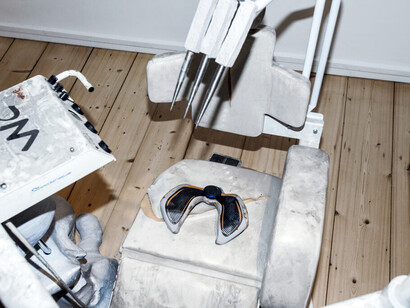
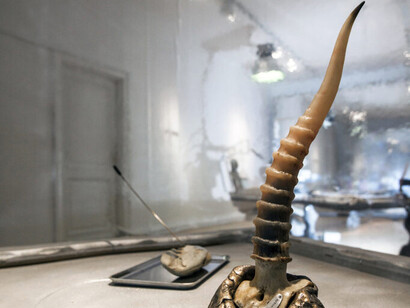
Hirtentreu’s and Popolitova’s installation presents an aesthetic laboratory with an undefined temporal origin. It is partly a shrine, partly a clinic, where medical and cosmetic objects intertwine – everything from nail soakers, bootyshakers, gaze amplifiers and body triggers – as well as animal-derived artefacts and materials like silver, charcoal, and stone, all of which appear to be part of an attempt to invent yet another absurd beauty procedure promising eternal youth for the body. Through the materials used, the artists highlight the invasive methods and almost unattainable standards employed in the pursuit of beauty and youth.
For both Neanderthals and modern humans, appearance is linked to belonging. Archaeological findings suggest that Neanderthals used natural materials such as stone beads, bird claws, and red ochre as adornment. In addition to being decorative, such practices likely expressed belonging, status or indicated the position in the social hierarchy. Whereas earlier beauty rituals were tied to nature, the environment and the community, today’s beauty standards demand the body be constantly adapted to rapidly changing trends. This type of perpetual pressure to conform increasingly alienates people from their bodies. Beauty standards are no longer passed down slowly through traditions but instead disseminated via algorithms and screens. Beauty ideals are not only reflected but also created by social media.
Neanderthal beauty clinic juxtaposes the technological and the natural, the ancient and the contemporary, questioning under what conditions belonging is possible in today’s society. In neoliberal beauty culture, belonging is shaped not through shared experience, but through customised body norms. Although self-care is presented as an expression of personal freedom, in reality, it unfolds within an increasingly narrow aesthetic framework, where both body and mind must constantly adapt to external directives.