English
 Español
 Français
 Deutsch
 Italiano
 Português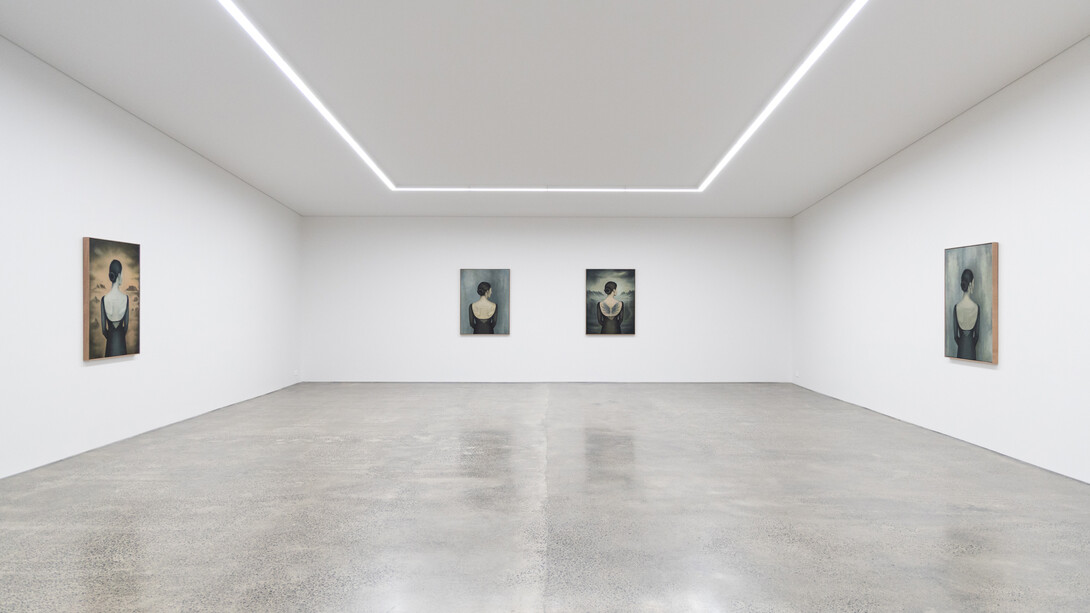
Heather Straka is a New Zealand artist known for her incisive explorations of identity, representation, and cultural hybridity. Straka trained in sculpture at Elam School of Fine Arts (BFA, 1994) and completed her MFA at the University of Canterbury in 2000. She was the 2008 recipient of the prestigious Frances Hodgkins fellowship at the University of Otago.
Straka’s early sculptural precision laid the groundwork for the immaculate technique that defines her painting. Straka’s work interrogates authenticity and the politics of representation, often through provocative re-imaginings of Western art-historical tradition and cultural stereotypes, drawing out and emphasising their ironies in the most aesthetically delightful way.
Straka’s recent work frequently interrogates the fetishisation of the gaze by staging encounters between viewer and subject that are both seductive and destabilising. Her meticulously rendered figures are posed in ways that invite voyeuristic scrutiny while resisting narrative closure. The absolute mastery of technique lulls the viewer into a false sense of security and familiarity.
The artist manipulates conventions of portraiture and display to expose the hierarchical and gendered dynamics of looking. The subjects, often anonymous, become proxies for broader questions of power, desire, and exoticism. Straka turns the gaze back on itself, revealing its complicity in constructing the Other. At the same time, they fully embrace their sensuality and eroticism.
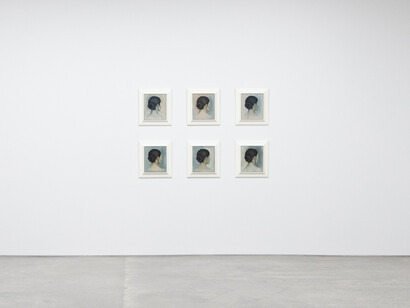
In this exhibition both ends of the gaze are represented. There are the familiar bare back viewed from behind portraits, anonymous and ironically objectified. In this case the subject is a ballerina, and emphasis is based on the strong back revealed by the backless leotard, like an Ingres odalisque. Uniforms are a frequent theme of Straka’s and the leotard is no different.
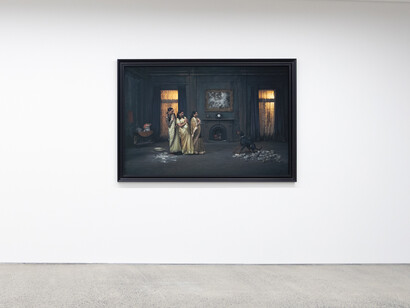
The same dancer, identically posed, becomes a serially repeated canvas for variations. In Wings of desire the dancer stands facing a mountainous monochrome landscape that recalls both the background of Leonardo’s Mona lisa but also the romantic Sublime of Caspar David Friedrich’s Wanderer above the sea of fog. Her back is painted with dripping black wings, perhaps alluding to Odile, the black swan of Swan lake.
In Lessons in space she stands against a flat, ambiguous, painterly plane covered with mathematics and may, or may not, be a blackboard. The final act places the dancer once more in a landscape, this time a brooding gothic skyline of skyscrapers echoing the mountains of the first painting, a faint nimbus around the dancer’s head.
With a nod to Judith Butler, the ballerinas evoke the disciplined, gendered body, trained to enact grace, control, and aesthetic submission. Their open-backed garments expose vulnerability while asserting agency, which has long been one of Straka’s core themes. The painting becomes an aesthetic collaboration, a performance, between the artist and the dancer.
The head studies function similarly. Seen only from the back, the model exists as both refusal and invitation, withholding the face yet intensifying the viewer’s desire to know, decode, or possess. The sitter is othered. The paintings offer a challenge to the traditional function of the portrait, denying both subject and viewer the gaze. We cannot be certain whether the model is vulnerable or defiant, rendered in exquisite detail, their identity suspended. The subject of the portrait becomes the Lacanian objet petit a, the hyper-visible, unattainable object-cause of desire, which always eludes capture and representation.
Thus. Straka evokes the politics of visibility and the ethics of representation, playfully subverting them. The turned back becomes a site of projection, where the viewer’s assumptions about race, gender, and power are laid bare. They are completely ambiguous, and that is the point. God is dead and all things are permitted. The viewer must interrogate their own inner monologue to decide what that means for them.
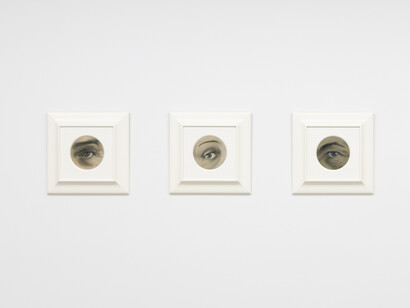
The Peephole paintings are far more confrontational but just as anonymous, single eyes peering through the peephole of circular apertures in their frames. They recall the fad for “lover’s eye” portraits that emerged in the late 18th century and peaked around 1803–1804, catalysed by the clandestine romance between the future King George IV and Maria Fitzherbert. George commissioned a miniature of his eye from the portraitist Richard Cosway and sent it to Fitzherbert with a marriage proposal. She later reciprocated with a miniature of her own eye.
The appeal lay in the eye’s ambiguity and intimacy: it offers a coded form of desire without publicly revealing the identity, simultaneously public and private. The eye’s gaze, melancholic, flirtatious, or watchful, carries emotional weight, suggesting presence, memory, and surveillance where the viewer is also the subject. The eye is what makes us human and alive to our fellow primates, the windows to the soul.
In Straka’s paintings these eyes are sightless, but still feel as though they are watching us like Lacan’s famous sardine can, and perhaps we modify our own behaviour in response, the watchers watched in some kind of Benthamian panopticon. From the perspective of the subject, how Lacan looked at the can, is really his own perception of himself. “In the depths of my eye the picture is painted, but the subject is not in the picture…if I am anything in the picture, it is always in the form of the screen…the stain, the spot.”
A peephole is both a lens and a barrier, a threshold between public and private, seen and unseen, social acceptability and the scandalous. These works may be read as allegories of access, secrecy, and the ethics of looking. We too are the Lacanian stain, the intrusion of the Real that destabilizes perception and reveals the subject’s division.
The eye is associated with conscious, geometrical vision, what we see and control. The gaze, by contrast, is not what the subject sees but what marks the subject as being seen. It is a point of subjective alienation, where the subject becomes aware of being an object in another’s field of vision. We are suspended in a purgatory between looking and being looked at, which can be quite jarring in a collective gallery experience.
In all of these works, the artist’s aesthetic strategy resonates with feminist scholar Sara Ahmed’s theory of “strange encounters,” where the stranger is not simply anyone unknown but constructed through cultural and colonial frameworks as somebody we already know. Straka’s figures, inhabit a liminal space between presence and absence, intimacy and estrangement, innocence and knowing.
By deconstructing the body into votive-like fragments, backs and eyes, Straka undermines the authority of the gaze and reclaims the subject’s agency, not merely as an object of desire, but as a self-empowered, sovereign enigma. Straka’s canvases are not just sites of visual pleasure but arenas of ethical tension, where the act of looking becomes a form of inquiry and critique. They are anti-portraits that resist the expectations of received tradition.
Ultimately, however, the intentions of the artist remain deliberately opaque and private. The paintings are offered up out of context as blank screens for the viewer to project their own interpretations and desires upon. There are no policed intentions, no rules, no framing narrative to dictate how the viewer experiences the work. They exist as a kind of fractured subjectivity that hides behind the deceptively smooth and flawless surface. We are not meant to know. It is up to us to decide what we want it to mean.
(Text by Andrew Paul Wood)