English
 Español
 Français
 Deutsch
 Italiano
 Português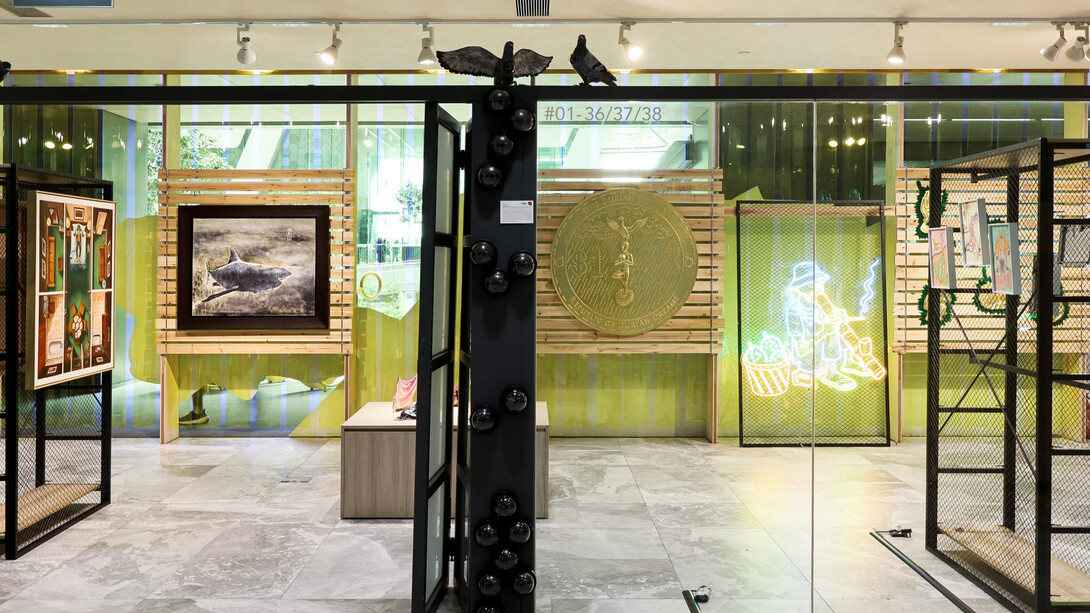
Local artists, fresh works, inspired by iconic painting in a vitrine gallery in the CBD, with the generous support of OUE Downtown Gallery (Venue Partner)’
What in Cheong’s painting lingers as suspended smoke thickens into a conceptual structure: the dream itself. The durian ceases to be mere commodity or motif; it transforms into a vessel of altered perception, an allegorical chamber where the subconscious finds form. Inside the Dream of a Durian Seller extends this notion and positions the durian as a stand-in for the art world. It brings together several exciting local voices in contemporary art, both established and emerging: Brandon Tay explores his own disgust of durians with a visceral, haptic video and sound piece; the Chun U Bi brothers honour and parody Singapore’s cultural icons and art market players in an Orwellian, Animal Farm-like twist with CNC carved wood artworks.
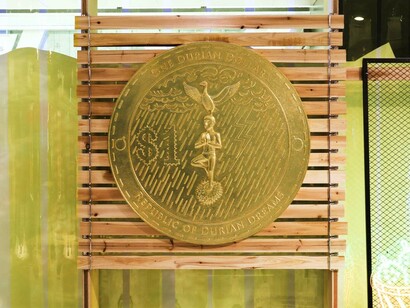
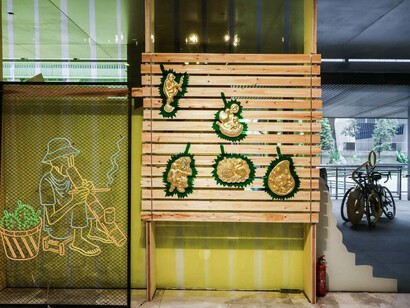
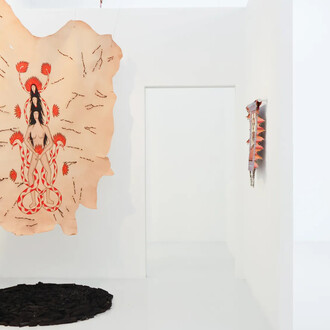
Chun U Bi’s series of CNC carved wood artworks reimagines the legacy of Singapore’s post-independence art history through the figure of a durian boy. Drawing inspiration from Cheong Soo Pieng’s painting, the humble street vendor is transformed into a mythic magician-like character in Chun U Bi’s artworks. The durian boy, emerging from within the thorned fruit, becomes a symbolic self-portrait of the artist—an homage to Lee Wen’s iconic Yellow Man and his enduring vision as a performance artist. Various stages of the durian boy’s artistic journey is depicted in a tongue-and-cheek humour and he eventually arrives at ‘enlightenment’, balancing precariously on a durian with a goose perched atop his head. The latter is forever immortalised on the face of a one durian dollar coin, which serves as an allegory of the art market and art as commodity. Chun U Bi’s works are both a tribute and a renewal: the durian boy who channels the lineage of Singaporean performance art into a contemporary myth of creation—where the artist constantly mediates between the everyday and the extraordinary.
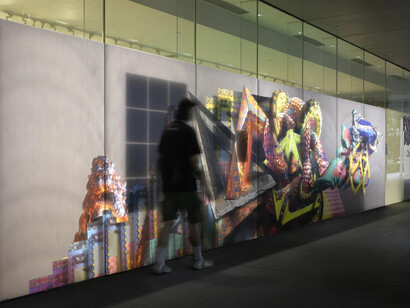
Brandon Tay draws upon Cheong Soo Pieng’s The Durian Seller and the writings of Malaysian-Chinese author Chang Kuei-Hsing to imagine a visual tone poem—a matrix of sensations where the abject becomes seductive. Taking the subject of Cheong’s painting as a point of departure, Insula speculates on what the titular Durian Seller might have experienced in their narcotic haze. The fruit, spikey and odorous, is a portal into the paradoxical condition of the tropical imaginary: where disgust and desire bleed into one another; where ripening and rotting are indistinguishable. Vapours and atmospheres carry states of intoxication and decay, dissolving the line between attraction and revulsion.
Mapping poles of experience between hallucination and addiction, infection and sensation, the work unfolds as a sequence of visual skits. These slip between mediums: the folkloric flatness of 2D cel animation, the grotesque mutability of Cronenbergian flesh, the compressed haze of vhs, and the accidental impressionism of pixelated mobile capture. Each mode exaggerates a different register of the uncanny tropics, as if the jungle itself were channel-surfing across styles of image-making to make sense of contradictory forms of sordid fascination. Beneath these surfaces circulate conditions never fully described: speculative maladies whispered rather than diagnosed, felt more as atmospheres than as names. They are present in the sweetness that drips, the vapours that thicken, the soils that exhale. Rather than narrative, INSULA composes a fevered terrain: fruits leaking syrup, soils exhaling bile, vapors heavy with rot. In this ecology, matter itself becomes medium, each secretion hinting at the presence of ailments that remain unnamed, yet palpable.
Musang Kings by Jimmy Ong is a depiction of native men having durian on what appears to be Penang Hill in Malaysia, crowned by the Convalescent Bungalow, where the artist once had his studio. Its title is a direct reference to a variety of durians popular in Malaysia and Singapore, or more commonly known as ‘‘Mao Shan Wang’ for the latter, playfully suggesting the three characters as kings of the ‘Cat Mountain’ or ‘Hill of Cats’.
This act of communal eating and gathering in nondiscreet places recalls the heightened desire for companionship and camaraderie during covid times, where isolation and social distancing were enforced. Having lived in New York for several years before moving back to Southeast Asia in 2010, Ong’s drawings often reflect on the notions of community and individuality in different cultural environments. He also notes the lack of pictorial representation of gatherings within Singapore, where demonstrations and congregation are strictly limited, this work being a subversive nod to the country’s laws on unlawful assembly.
Teng Jee Hum presents a haunting meditation on endurance, mortality, and national identity in Hence in 50 years (2012). A great white shark looms in the dim, murky waters—its recent kill betrayed only by a faint trace of red in its mouth. Nearby, half-submerged and ghostlike, stands the Merlion, Singapore’s iconic monument and symbol of pride. The painting evokes two intertwined episodes from Singapore’s recent cultural and political memories. One recalls an ambitious plan to transport the Merlion to the Venice Biennale—a concept that ultimately remained unrealised, reduced to its barest form as a set of instructions. The other references a moment when a young politician asked his senior colleagues to raise their hands in belief that Singapore would endure another fifty years. Teng fuses these sociopolitical fragments into a powerful allegory of uncertainty and reflection. Beneath its surface, Hence in 50 Years poses a question that lingers beyond the canvas: what will survive the next half century, and at what cost?
Cracking godalisation (2025) is a collaborative work between Teng Jee Hum and Chun U Bi. Chun U Bi which seeks to reframe Teng Jee Hum’s practice, presenting his dual role as artist and art collector through a playful yet reflective gesture. Set within a capsule toy vending machine, a reproduction of one of Teng Jee Hum’s Lee Kuan Yew paintings is cut into vertical strips and interwoven among transparent capsules containing fortune cookies that hold bite-sized prophecies taken from the collector’s primer. When the machine is full, the image appears mangled and distorted, obscured by the capsules. As each capsule is dispensed, the number inside gradually decreases, and the portrait slowly begins to reveal itself.
The work recalls the childhood ritual of playing with capsule machines, evoking nostalgia while engaging with the idea of zeitgeist explored in Teng Jee Hum’s writings on how certain figures and symbols, such as Lee Kuan Yew, become deeply entrenched within the national psyche and continue to shape generations to come. Each fortune cookie releases a slip of thought on taste, value, time, or the spirit of the age—quotes taken from Teng Jee Hum’s book Godalisation–Singapore Painted: A Personal Primer to Collecting Singapore Art. These fortunes transform his reflections on art collecting into playful fragments of wisdom, where chance and meaning intersect. In Cracking Godalisation, the fortune cookie becomes both joke and oracle: knowledge passed hand to hand, crumbs of guidance for an uncertain art future.
Tisya Wong, a fresh voice in local contemporary art, takes over the “dressing rooms” and presents Economy of scales. Drawing from the practice of amplifying measurements as a sales strategy among certain durian vendors, the work reveals how perception can be shaped and leveraged, inviting viewers to reconsider the systems that define worth in everyday life.