English
 Español
 Français
 Deutsch
 Italiano
 Português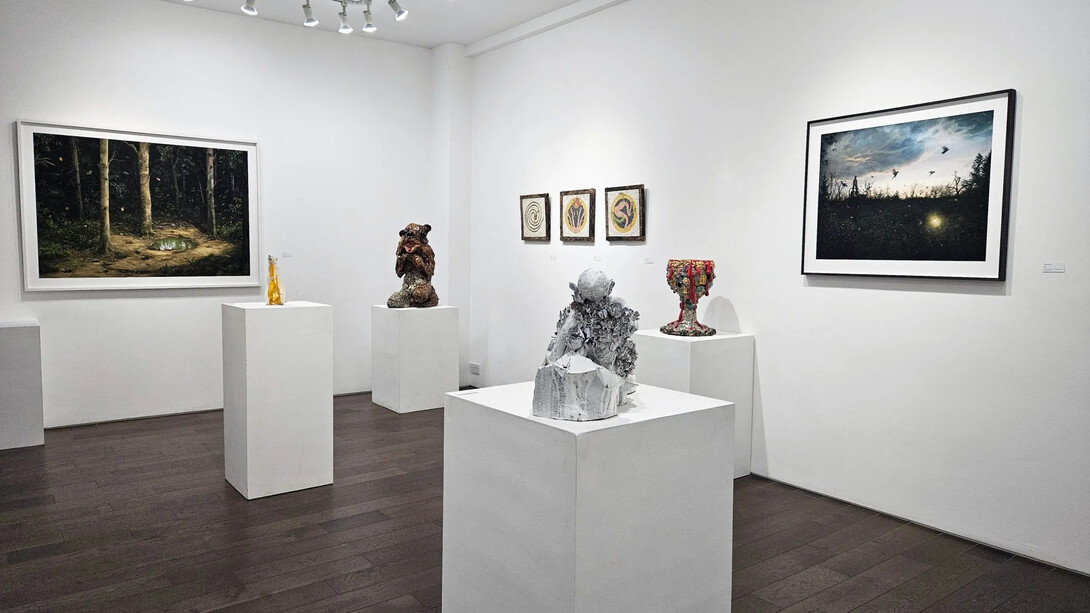
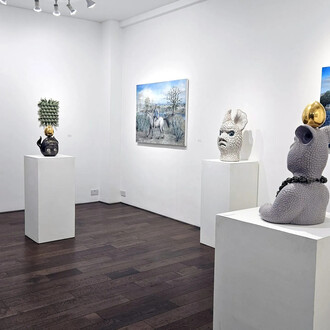
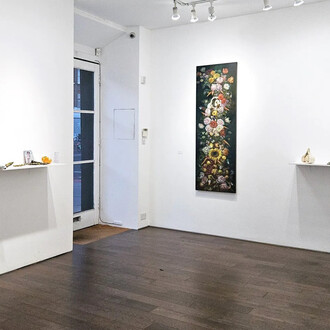
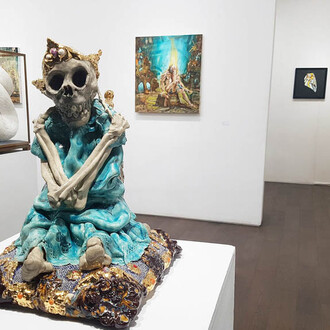
Deep midwinter is an exhibition about the magic of the darkest time of the year: the heart of winter that plays host to the winter solstice, to Christmas, and the change of the old year into the new. Several motifs run through the works – gold, fire, and ritual – as well as themes like nature and decay, darkness and transformation. The exhibition features the work of eight contemporary artists: Carolein Smit, Zatorski + Zatorski, Claire Curneen, Suzanne Moxhay, Hellen van Meene, Chantal Powell, Carlos Zapata, and Guillermo Martin Bermejo.
Suzanne Moxhay’s photocollages explore the penumbra of the forest as an echo of the darkness of winter, depicting wooded scenes with unsettling undertones, ripe with both magic and menace. Beneath the low light in the winter sky, will-o-the-wisp manifestations glow in the thickets amidst falling leaves and fluttering birds. Far from a simply time of decay, Nature comes alive with imaginative possibilities.
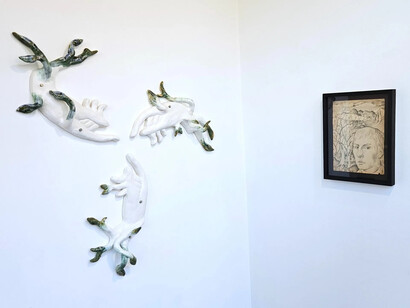
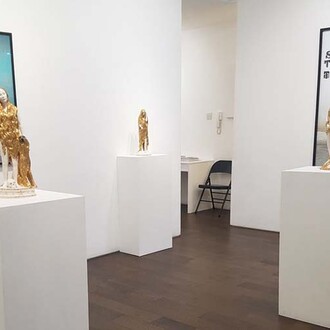
Claire Curneen’s ceramic figures explore the uncertain space between the earthly and the ethereal. One standing figure is covered in gold in an echo of the gift of the Magi. Gold’s symbolism in Claire’s work is of a higher spiritual plane, like a brush with a greater state of being. Her accompanying figure lies festooned with flowers, an animated being springing from the raw clay of the earth.
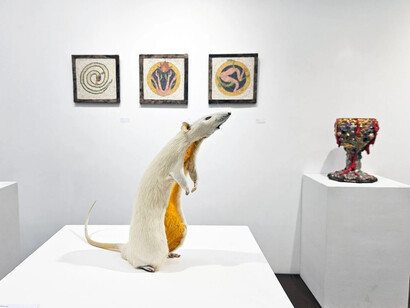
Zatorski + Zatorski’s installation of 101 preserved white rats lined with 24 carat gold won the Jack Goldhill Award for Sculpture at the Royal Academy Summer Show 2025. Individually entitled The one, these rodents use gold’s ancient symbolism to suggest the precious individual nature of the outsider, and speak of the imperative of the survival of uniqueness in an era of encroaching homogeneity.
Carolein Smit’s sculptures look at the ritual charge of winter as a time for transformation. Her oversize ceramic Grail echoes the deep narrative power of the ritual feast: encrusted with jewels, glittering and glistening, it brims with the promise of change. Delving deeper into the ritualistic past, a shaman sits peering out from within a bearskin, an echo of older, more animistic instincts.
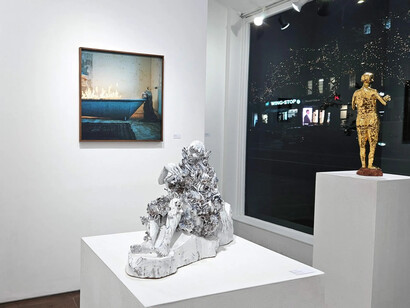
Carlos Zapata’s polychromed wood sculptures also look at ritual. A madonna sits on a throne lined with gold while an accompanying figure prays in kneeling contemplation, echoing Christian Christmas traditions. A third figure has deeper ritual connotations: of burnt offerings and the organic connection of the human with the earth, and fire as more than just a source of heat and light.
Hellen van Meene’s photographic portraits depict young women on the cusp of change: from adolescence into adulthood, dark into light, comfort into danger. A young woman stands in the shadow of a medieval cloister as if in trepidation of the future; another lies in a bath surrounding by flame and danger. Fire and the darkness echo in Hellen’s works as potent symbols of uncertainty and change.
Chantal Powell’s artworks delve into the unconscious and its motifs, informed by Jungian psychology and alchemical symbolism. Her mosaics echo the tessellated nature of the unconscious, her ceramics the cyclical elements of a ritualised dance. All depict organic forms like archetypes in ancient rites, links between the inner psyche and the transformational patterns of the natural world.
Guillermo Martin Bermejo’s pencil drawings on rescued paper depict three artists who explored the relationship between physical nature and the mystical in their work. The quintessential Romantic landscape painter Caspar David Friedrich appears, uncertain, in an oak grove; a brooding Francis Bacon glowers on the page against a looming dark background; and a young Paul Klee looks out with childlike innocence and promise.