English
 Español
 Français
 Deutsch
 Italiano
 Português
Recent food recalls highlight a troubling reality: refrigeration and adherence to “use by" or “best By” dates aren’t always enough to keep us safe. This issue is particularly pressing now, as more people are preparing meals at home, leading to a greater reliance on home food storage and handling practices. Take these examples:
Oscar Mayer turkey bacon: Kraft Heinz recalled 367,812 pounds of fully cooked bacon produced between April 24 and June 11, 2025, due to Listeria contamination. Although no illnesses have been reported, the USDA classified the recall as Class I, the highest risk level, indicating a situation where there is a reasonable probability that using or being exposed to the product will cause severe health consequences or even death.
Organic blueberries: Around 400 boxes (~12,000 lb / ~5,443 kg) were recalled after Listeria was found in frozen berries—despite proper handling and dating.
Wall’s Classic Scotch Eggs: UK authorities recalled packs that were still within their “Use By” period after detecting Salmonella—undermining the assumption that date labels guarantee safety.
International Delight creamers: Over 75,000 bottles of cinnamon roll and hazelnut creamers were pulled across 31 states after reports of spoilage and consumer illness, even though they remained within their “Best By” dates. The FDA designated this a Class II recall, reflecting a moderate risk level, where the use of or exposure to a violative product may cause temporary or medically reversible adverse health consequences, or where the probability of serious adverse health consequences is remote.
Consumers tend to believe that refrigeration plus a “use by" or “best by" label equals safety. But these high-profile incidents show that cold storage and date compliance can still fail, leading to serious health threats and food waste, especially when pathogens are involved.
Why refrigeration and dates aren’t enough
It’s easy to assume that if your food’s in the fridge and hasn’t passed its expiration date, it’s safe to eat. But the truth is more complicated. Several overlooked factors, from fridge temperatures to confusing date labels, can put your food safety at risk. Let’s break down the key reasons why cold storage and labels don’t always tell the whole story.
1. Your fridge is probably too warm
A landmark ANSES study across 16 European countries, covering nearly 10,000 home refrigerators, found the average domestic fridge temperature to be 6.4°C (43.5°F). That exceeds both the Codex Alimentarius recommendation of ≤ 6 °C and the FDA’s stricter ≤ 4 °C guideline.
Why does this matter? Listeria monocytogenes, a pathogen known for its resilience, can grow at temperatures as low as 2–4°C and continues to multiply even at 6–7°C. Studies suggest that keeping food at these warmer fridge temps can increase listeriosis risk by nearly 20× compared to properly cooled storage at 3°C.
A Dutch follow-up revealed that while lower fridge shelves averaged around 5.7°C (42°F), some interior “hot spots" due to poor air circulation or overpacking spiked as high as 17°C (62°F) during warm days, creating ideal conditions for bacterial growth.
2. Hidden hotspots breed bacteria
It’s easy to think a quick wipe makes your fridge clean, but dangerous microbial hideouts lurk in spots often overlooked:
Biofilms in fridge seals, drains & gaskets: Listeria monocytogenes thrives in biofilms, persistent communities that resist standard cleaning. These slimy matrices protect bacteria from disinfectants, even in processing environments. Once established, biofilms continuously shed pathogens, leading to ongoing contamination risks inside the fridge.
Home kitchens aren’t blameless either: A study of 100 urban homes found Listeria species in 15% of refrigerators, especially on meat-drawer surfaces and its presence was significantly linked to higher fridge temperatures. Meanwhile, NSF research identified vegetable compartments as among the dirtiest spots in home fridges, routinely testing positive for Listeria, Salmonella, yeast, and mould.
Kitchen cleaning tools also harbour germs: Sponges and brushes frequently test positive for Salmonella and 107–1010 total bacteria, with damp sponges proving especially hard to disinfect. Interestingly, salmonella-infected brushes reduced contamination more quickly than sponges but neither was fully sterile.
Bottom line: These biofilm hotspots don’t just escape cleaning; they may actually spread pathogens continuously if left unchecked.
3. Cooling food takes time—it's not instantly safe
Contrary to common belief, placing hot leftovers directly into the refrigerator doesn't immediately halt bacterial growth. In fact, the USDA highlights that hot foods can remain in the "danger zone"—temperatures between 41°F and 140°F (5°C and 60°C)—for 3 to 5 hours while cooling internally. During this period, bacteria can double in number every 20 minutes, significantly increasing the risk of foodborne illness.
The FDA's two-stage cooling method further emphasizes the importance of rapid cooling:
Cool food from 135°F to 70°F (57°C to 21°C) within 2 hours.
Cool food from 70°F to 41°F (21°C to 5°C) within the next 4 hours.
However, many households struggle to meet these guidelines, especially when dealing with large or deep containers. Such conditions can trap heat in the centre of the food, allowing bacteria to proliferate unchecked.
This underscores a critical vulnerability in food safety: improper or slow cooling can render refrigerated foods unsafe long before their "use by" dates, highlighting the need for more stringent cooling practices.
4. Date labels mean quality, not always safety
Many consumers mistakenly believe that food labelled with “best by” or “use by” dates is unsafe to consume after those dates. However, these labels often indicate peak quality rather than safety. A 2025 national survey by ReFED revealed that confusion over these dates leads U.S. consumers to discard approximately 3 billion pounds of edible food per year, valued at about $7 billion.
Despite 87% of consumers claiming to understand the meanings of various date labels, only about 53% answered correctly when tested. This widespread misunderstanding contributes to unnecessary food waste and potential foodborne illness risks.
Practical guidance: how to take control of your food safety
While refrigeration and date labels aren’t fool proof, you can significantly reduce risk by adopting a few mindful habits:
1. Practical fixes to keep your fridge colder and safer
Use accurate thermometers in key spots: the FDA recommends using an inexpensive appliance thermometer placed near the fridge's centre to get a true internal temperature; relying on the dial isn’t enough. A large-scale consumer survey found that only 11% of households routinely used a thermometer, while 71% of fridges were actually operating above the safe 5°C (41°F) threshold. Proper thermometer use can help maintain fridge temps at ≤ 4°C (40°F), slowing growth of dangerous pathogens like Listeria by up to 70%.
Keep your fridge two-thirds full: experts from Beko and Tom’s Guide emphasize that fridges operate more efficiently when about two-thirds full; this allows cold air to circulate without overloading. Proper loading prevents temperature spikes and helps maintain a consistent cold environment.
Manage door openings and contents: data shows frequent or prolonged door openings can cause 5–10°F temp spikes, briefly pushing items into unsafe zones.
Positioning perishable items (e.g., meat, dairy) at the back and bottom shelves ensures they stay ~5–7 °F colder than food stored in warmer areas like the door.
Seasonal & proximity adjustments: appliance experts recommend setting your fridge to around 3°C (37°F) during hot seasons or when heavily stocked to offset ambient heat and frequent door opening. Additionally, ensure your fridge isn’t tucked against heat sources; leave a 5 cm gap on all sides for proper ventilation.
2. Unidentified spots generate germs
To tackle the hidden biofilm and germ problem in common fridge zones, implement these evidence-based cleaning protocols:
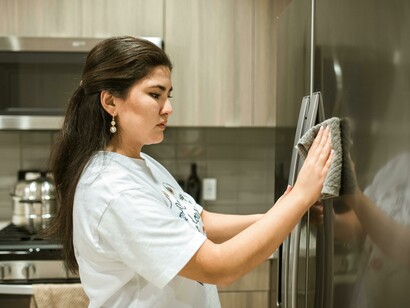
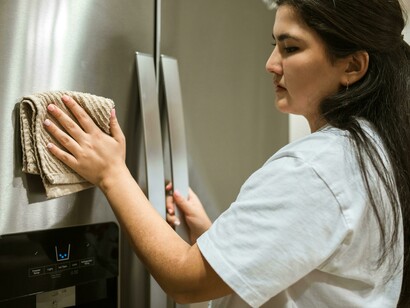
Deep-clean door seals and gaskets: Biofilms and debris accumulate in rubber gaskets, compromising both hygiene and seal efficiency. Experts recommend wiping gaskets monthly with a soft cloth and a solution of warm water and mild detergent or vinegar diluted 1:1 with water, then drying completely to prevent moisture build-up and mould growth.
Disassemble and wash drawers (produce & meat compartments): NSF research and university extension guides identify drawers as hotspots for Listeria and other pathogens. Remove drawers and wash them monthly or immediately after raw spills using hot soapy water (followed by thorough drying) or a baking soda solution (2 tbsp per quart of warm water) to break down grime and odours.
Clean drains and hard-to-reach areas: Fridge drain holes and interior crevices trap moisture and food particles that feed biofilms. Clean these spots monthly with a cotton swab or pipe cleaner dipped in vinegar or mild detergent, then rinse with clear water to remove residues.
Launder or replace sponges and cleaning cloths: Kitchen sponges can harbour up to 10⁹–10¹⁰ CFU of bacteria. The CDC and Clemson University recommend replacing sponges every 1–2 weeks and sanitizing reusable cloths after each use or replacing them weekly to prevent cross-contamination.
Sanitize the interior after deep cleaning: After washing surfaces, apply a food-safe sanitizing solution, such as 1 tbsp unscented bleach per gallon of water or straight white vinegar, to all interiors. Allow the solution to sit for 5 minutes before air-drying to ensure reduction of Listeria and Salmonella.
Wash cleaning tools between tasks: Prevent cross-contamination by using separate cloths or sponges for raw meat areas versus general surfaces. Sanitize or microwave (wet) sponges for 1 minute after each use to kill lingering bacteria, then let them dry fully.
3. Cooling food takes time
To prevent hot foods from lingering in the bacterial "danger zone" (41°F–140°F or 5°C–60°C) and multiplying pathogens, use these effective cooling techniques backed by USDA, FDA, and CDC guidance:
Divide food into tiny portions: The FDA and USDA both emphasize that large or deep containers trap heat and delay cooling. Transferring cooked food into shallow containers less than 2 inches (~5 cm) deep increases surface area, allowing heat to dissipate more quickly and reducing the time food spends in unsafe temperature ranges.
Stir or agitate food while cooling: The CDC recommends stirring soups, stews, and casseroles during the cooling process to break up heat pockets and promote even temperature distribution, accelerating cooling past the critical 135°F (57°C) mark.
Use ice baths or cooling aids: Food safety experts suggest placing containers in an ice-water bath or surrounding them with ice packs during initial cooling. This method rapidly reduces the temperature before refrigeration and shortens the time food remains in the danger zone, significantly reducing bacterial growth risks.
Avoid overcrowding the fridge: Scientific reviews on cold chain management highlight that overcrowded refrigerators restrict airflow and reduce cooling efficiency. Leaving space between containers ensures proper circulation of cold air, which facilitates faster, uniform cooling.
4. Date labels prove quality, not necessarily safety
Many consumers confuse date labels on food packaging, leading to unnecessary food waste and potential health risks. Understanding the true meaning behind these labels can empower you to make safer and more sustainable choices.
4.1. Standardize date labels: why it matters
Inconsistent and confusing date labels cause about 20% of consumer food waste, according to a 2021 ReFED report. Ambiguous terms like “Sell By,” “Best Before,” and “Use By” vary widely in meaning and are often misunderstood.
Real-world example:
California’s law (effective July 1, 2026) mandates clear, consistent date labels:
“Best If Used By" indicates the date by which the product will maintain its best quality (flavor, texture, appearance). Foods are often safe beyond this date.
“Use By” is the safety cut-off date, mainly for highly perishable foods like dairy and meat, after which consumption risks increase.
The confusing “Sell By” date is being eliminated for consumer-facing labels to prevent premature disposal.
4.2. Educate yourself on label definitions
The label definitions according to the USDA Food Safety and Inspection Service and the FDA are,
Best By/Best Before: These dates relate to quality, not safety. For example, canned goods and dry pasta often remain safe long after these dates if packaging is intact.
Use By: Primarily on perishable items, indicating when the food is no longer guaranteed safe.
Sell By: Intended for retail inventory management, not a safety indicator.
4.3. Look beyond the date: sensory evaluation
The FDA and USDA recommend consumers trust their senses alongside date labels:
Smell: Off or sour odours are red flags.
Appearance: Mould, discoloration, or sliminess are signs of spoilage.
Texture: Changes like excessive softness or stickiness can indicate food is no longer safe.
4.4. Store foods properly to extend shelf life
Proper storage is critical to keep food safe past its labelled date. For example:
Refrigerate perishables promptly at or below 4 °C (40 °F).
Freeze dairy, meat, and bread products to safely preserve them well beyond printed dates. The USDA’s FoodKeeper app offers detailed storage timelines.
Avoid temperature fluctuations—keep your fridge closed as much as possible to maintain stable cold temperatures.
4.5. Plan and rotate food stocks: FIFO method
Using the First In, First Out (FIFO) approach helps:
Use older items before newer ones.
Reduce waste from foods expiring unnoticed.
Keep your pantry and fridge organized with clear labelling of dates once opened.
Conclusion
While your refrigerator and product expiration dates are important tools, they are not infallible guardians of your food safety. The recent increase in home cooking has only amplified the need for greater awareness. By understanding the nuances of temperature control, tackling hidden microbial hotspots, practicing proper cooling techniques, and deciphering date labels, you can significantly reduce the risk of foodborne illness and minimize unnecessary food waste. Ultimately, empowering yourself with this knowledge is the coldest truth—and your best defence—in the kitchen.
Notes
Centres for Disease Control and Prevention. (n.d.). Cleaning your refrigerator because of a food recall.
Food and Drug Administration. (n.d.). Safe food handling.
Food Safety News. (2025, April). Advice revised after refrigerator temperature study findings.
NSF International. (n.d.). How to clean the germiest kitchen items.
ReFED. (2025). Consumer perceptions of food date labels: 2025 national survey & policy brief .
ReFED. (n.d.). Digging into date label policy in the U.S..
ScienceDirect. (n.d.). Listeria monocytogenes.
State Food Safety. (n.d.). How to clean and care for your fridge.
State Food Safety. (n.d.). The two-stage cooling process: How to cool food properly.
U.S. Food and Drug Administration. (2024). Food code: Cooling cooked time/temperature control for safety foods.